   |
||
| Issue No 88 |  |
16 March 2001 |
|
|
|
|
||
| Issue No 88 | |
16 March 2001 |
|
|
|
NSW Premier Bob Carr, who visited the workers' picket outside Grenadier Coating in Matraville this week, has referred the allegations to his Attorney General Bob Debus.
At least six workers have lost up to six months of private superannuation payments that were supposed to be paid directly from their pay-packets into the fund by their employer.
And another worker who's wages were being garnisheed to meet family support commitments has discovered this money has not been paid.
The workers have been maintaining a picket outside the Matraville factory since last week when they were told their jobs were no more and that they would not get their entitlements because big business creditors like the St George Bank-owned Scottish Pacific took precedence.
Worker and TCFUA delegate Michelle Booth told Labor Council that the Administrator has refused to guarantee the payment of entitlements and is encouraging workers to break the picket - on the grounds that this is the only way they'll receive anything.
Mad Monk Catches Up With Old Mate
As Labor Coucnil affiliates and the NSW Premier visited the picket this week to offer their support, an unwelcome visitor also appeared in the form of federal Workplace Relations Minister Tony Abbott.
Booth says, instead of offering his support, Abbott was there to visit the Administrator - "an old drinking buddy".She says Abbott was encouraging workers to cross the picket and said the issue of the unpaid superannuation contributions was "not his concern".
Abbott was also encouraging workers to accept the government's tax-payer funded entitlement safety net payment, which would deliver workers just a fraction of the money they are owed.
Labor Council acting secretary John Robertson pointed out that the Howard Government's scheme hit older workers the hardest, by capping accrued entitlements such as redundancy and long service leave.
"This puts older workers in a double jeopardy - not only do they lose more iof their entitlements, they are typically the workers in the demographic which finds it hardest to find a new job," he says.
Labor's Vow: Entitlements 100 Per Cent Protected
Federal shadow Attorney General Robert McClelland told Labor Council that a Beazley Labor Government would protect workers entitlements "one hundred per cent".
McClelland says Labor has calculated workers could receive comprehensive coverage if a small levy were added to their insurance payments. That figure would be less than point one of one per cent of the current exposure.
The Cricket Line
The workers are keen to take on any comers on the make-shift picket cricket pitch.
Labor Council, who have donated a brand-now Kookaburra bat, is rustling up a team for a Wednesday challenge. Any one keen to play hit the button below.
The double breakthrough adds momentum to the push to have the ACTU's Call Centre Code of Conduct adopted across the burgeoning industry.
The Gallap Western Australian state government became the first administration to formally accept the code and charter, with WA Labour Relations Minister John Kobelke poised to take the agreement to Cabinet.
Once adopted, call centers providing services to the state government will be expected to comply with the code, which will also be taken into account when allocating investment assistance and contracts..
And NSW Industrial Relations Minister John Della Bosca says "the NSW Government supports the general concepts and principals contained in these proposals as a means to ensure minimum standards in this growing industry."
He has proposed establishing a Working Party of union and government representatives to review the Code and examine its potential application.
The breakthrough follows a meeting with NSW Labor Council acting secretary John Robertson this week where the Minister's office was briefed on the need for the code.
Workers Slay Giant
Menawhile, International call centre giant Sitel, has a reached an agreement with the Australian Services Union on an enterprise agreement covering their 300 seat call centre in Sydney.
Sitel is an outsourcing call centre that performs customer service for a wide range of Australian and international companies.
The agreement enhances Sitel's drive to be an "employer of choice" in the competitive call centre industry where the labour market is tight with employees voting with their feet when pay and conditions do not measuring up to the expectations of the job.
Sitel and the ASU have negotiated an agreement that sets pay levels well above the industry average, extends breaks, introduces penalty rates, overtime and other standard benefits for an industry that does not yet have an Award.
"The aim of the agreement is to ensure staff are happy with their employment conditions. Sitel saves money through reducing employee turnover and, it makes them even more competitive by attracting the best call centre staff in Sydney" ASU organizer Sally McManus says.
"Our members are very happy with the agreement with 80% of employees voting in it's favour. Sitel has taken a different approach to many employers in the industry who have been unwilling to negotiate fair employment conditions with the ASU and have instead opted for individual contracts. These employers will continue to suffer through high employee turnover and frustration from employees who feel they do not have an effective means to voice their issues".
The ASU is negotiating with other major call centres across Australia on the same basis. Many call centre managers respect the desire of their staff to have a collective and an informed voice through the ASU.
Employers who continue to ignore their staff's concerns will continue to suffer high turnover costs, "Don't underestimate word of mouth. Call centre employees quickly work out who's good to work for and who to avoid", McManus says.
by Dermott Browne
The Community and Public Sector union says the cuts are mostly from rural and regional areas including Townsville, Geelong and Toowoomba.
Up in arms over shrinking staff numbers and growing client queues, government welfare workers are taking their concerns to local communities and MPs. Centrelink staff will meet next week to plan a lobbying campaign aimed at ensuring Centrelink has enough staff to do its job properly.
CPSU spokesperson Mark Gepp says Centrelink staff have been infuriated by recent Government 'spin' suggesting Centrelink staffing is increasing, not decreasing.
"Let's not forget that this government has cut 5,000 jobs out of the agency over the last couple of years," said Mr Gepp.
As a result of the Government's relentless winding back of staff numbers, Centrelink service levels are being affected. Centrelink's own internal reports show that more than 80% of clients can't get through to an operator when they call. Similarly, the waiting time for job seeker interviews has now blown-out to two weeks because of staff shortages.
"Our members are taking this issue directly to the community and local politicians. As the economy contracts, more and more Australians will need our help. It is vital that the Government reverses the cuts to Centrelink staffing," added Mr Gepp.
The Figures
Adelaide: June 2000 244; Feb 2001 228
Bendigo : June 2000 101; Feb 2001 103
Brisbane June 2000 289; Feb 2001 256
Bunbury June 2000 242; Feb 2001 224
Cairns: June 2000 116; Feb 2001 115
Cardiff: June 2000 150; Feb 2001 135
Coffs Harbour : June 2000 132; Feb 2001 104
Darwin: June 2000 25; Feb 2001 24
Geelong: June 2000 308; Feb 2001 176
Gosford : June 2000 163; Feb 2001 154
Hobart: June 2000 114; Feb 2001 107
Illawarra: June 2000 144; Feb 2001 113
Kalgoorlie: June 2000 1; Feb 2001 7
LaTrobe: June 2000 236; Feb 2001 172
Launceston: June 2000 79; Feb 2001 89
Liverpool: June 2000 197; Feb 2001 176
Moorabbin: June 2000 321; Feb 2001 258
Moreland: June 2000 168; Feb 2001 128
Perth: June 2000 149 Feb 2001 160
Perth City: June 2000 124; Feb 2001 108
Port Macquarie: June 2000 128; Feb 2001 117
Sydney : June 2000 156; Feb 2001 132
Toowoomba: June 2000 113; Feb 2001 107
Townsville: June 2000 182; Feb 2001 110
Tweed: June 2000 94; Feb 2001 81
Wendouree: June 2000 135; Feb 2001 137
TOTAL: June 2000 4111; Feb 2001 3521
The Municipal Employees Union says it is asking its members working at beaches, pools and aquatic centers to back the Speedo workers, who were thrown out of their jobs earlier this month.
"The MEU believes that this trend of clothing being manufactured in sweatships by workers without decent wages and condition must be reversed in Australia," MEU state secretary Brian Harris says.
Harris says the union will ensure such a protest does not breech secondary boycott laws while protecting individual members' rights.
Other unionists are also backing the Speedo workers, collecting old Speedo cossies are returning them to the company.
The Textile. Clothing and Footwear Union says that since the closure Speedo has been giving out its work to contractors, with the work ending up in sweatshops and outworkers' homes.
TCFUA state secretary Barry Tubner says the outworkers employed by Speedo contractors are receiving up to $150 below the weekly award rate, with no leave or superannuation entitlements or workers compensation.
by Andrew Casey
The union will ask for a clause to be inserted into their Enterprise Agreement guaranteeing that all their uniforms will be manufactured by companies signed up and accredited by the FairWear No Sweat Shop label campaign.
The LHMU National Executive voted this week to include in all Enterprise Agreement talks a claim for a No Sweat Shop label on workplace clothing worn by members whether they be in the hospitality, health, cleaning, security or manufacturing industries.
" School kids are campaigning to make sure their school uniforms are not produced by sweated labour, now their parents, in their workplaces, are joining this very popular campaign to deliver decent working conditions, and fair wages, to garment workers," LHMU Assistant National Secretary Tim Ferrari said.
The Starwood Hotel chain has about a dozen hotels in Australia , including the up-market Westin and W hotels, the Sheraton-on-the-Park, Sheraton Towers Southgate and a number of other smaller Sheraton hotels.
" We are happy with the fact that a number of employers in our industries are already using uniform manufacturers who are signed up to the Fair Wear campaign.
" We are looking now to spread this process to any workplace where our members have to wear workplace uniforms or other specialised clothes," Tim Ferrari said.
" Many of our members have relatives working as homeworkers in the clothing industry, so they have first hand experience of the exploitation that goes on in this industry," Tim Ferrari said.
" That's why this union is enthusiastic about standing up and being counted in helping garment workers get a better deal."
The LHMU is writing to the ACTU and State Labor Councils asking them to get other unions behind this campaign -and asking them to ensure that any union caps, clothes and jackets are also made by a manufacturer who has signed up to the FairWear campaign.
"We are also reviewing all our own LHMU clothing to ensure that they fit into the campaign," Tim Ferrari said.
Union members wearing workplace clothing can get behind the FairWear campaign by checking out the No Sweat Shop website ( http://www.NoSweatShopLabel.com) and asking their employers to make sure their workplace clothes come from one of the signatories to this campaign.
Sixty-seven year old Aurileo Tupas had the fingers severed while working on a Giben Beam saw at the Sleep City Furniture Manufacturing Facory at Wetherill Park on Monday.
The worker, who was semi-retired, underwent emergency surgery after being forced to travel to hospital in a taxi when the employer refused to call an ambulance. Some digits have been re-attached, but at least one has been lost.
CFMEU furniture division secretary Brian Parker says the accident followed a stand-off between management and workers over the establishment of a safety committee for more than 12 months. While management has finally agreed to the committee, there has still been no meeting.
Parker says that CFMEU officials have raised concerns about the Giben Beam Saw and has told Sleep City management for the last two years that they were not safe.
The accident this week occurred on a saw that had no guarding or safety shutdown, while other machines in the factory were inoperable because water was leaking through the roof onto the floor.
CFMEU has called on WorkCover to conduct a full investigation into timber cutting machinery of an antiquated date.
by Andrew Casey
by Andrew Casey
by HT Lee

|
|
|
|
As sheets of panelling were dumped onto the back of a truck, clouds of dust could be seen everywhere.
A local resident came out to investigate the raucous and was shocked to discover the workers could be involved in removing asbestos from the house. He quickly notified his neighbours and the constriction union--the CFMEU.
CFMEU Safety Officer Steve Keenen immediately visited the non-union site and found there was no compliance with occupational health and safety legislation or asbestos removal regulations.
The residents in the surrounding houses were not informed about the removal of asbestos nor were there any signs erected--indicating asbestos removal was in progress.
The CFMEU immediately closed down the site, made sure the council and the contractor has erected proper signs on the site and contacted the NSW WorkCover Authority.
The vacant house in question was to be demolished as part of Leichhardt Council's parkland plan in the area. N Mott & Sons Earthworks was contracted by the council to do the job.
The council's parks manager Vince Cufumano claimed the removal of the 'alleged' asbestos sheetings were done according to the code of practice and there was no dust in the air when he arrived at the scene. Mott according to Cufumano was not 'a fly by night' contractor and the council had used them before and were satisfied with their work.
However, local resident Kelly refuted this and said she could see clouds of dust in the air from her house further down the road.
'When I went down to the scene I had to tell them to cover up the sheeting in the truck,' she said.
When removing AC sheeting--they were supposed to damp it first and then cover them up. The contractor Mott did not follow those basic instructions.
The council and Mott also tried to claim the sheeting might not be asbestos but hardiflex and the residents should not be alarmed until independent test had been carried out.
The CFMEU also took a sample of the material and send it to the Workers Health Centre which specialise in occupational health and safety and has carried out numerous independent asbestos tests.
The test came back positive. The materials contains two types of asbestos--amosite and chrysotile. However, according to Cufumano, council's testing could only find one type of asbestos--chrysotile.
According to the residents no sampling from their property were carried--they want the council to check their property for asbestos contamination. But Cufumano said there were no traces of asbestos found in the neighbourhood.
The CFMEU has circulated a leaflet in the area explaining the situation. The leaflet said:
This type of cost cutting threatens the health and welfare of local residents. We are demanding the contractor be penalised and prosecuted.
We are also very concerned Leichhardt Council has not allocated adequate resources to monitor safety compliance--especially with its contractors.
The mayor of Leichhardt Council Maire Sheen and her media officer have refused to return calls to answer the following questions:
� Was there a work method statement for the demolishing of the building?
� Was a hygienist report done on the building and if there was why was the result of the presence of asbestos not being circulated to the residents and the proper procedure for the removal of the asbestos in place, and if there was no report done, why not?
� Why were the workers issued with protective gears if there was no asbestos?
� Why was a council representative not there to make sure the asbestos where removed in accordance with the code of practice?
� Why was there only one type of asbestos found by the council's test when in actual fact there were two types of asbestos found?
� Why were there no signs erected indicating asbestos removal was in progress?
� Why were the residents not notified about the removal of the asbestos?
Had the CFMEU not arrived at the scene, the demolishing and unsafe method of removing the asbestos would have gone on unchecked. Leichhardt Council should have made sure the removal of asbestos was properly supervised. It has failed in its responsibility and as a result has endangered the public.
The decision in the Administrative Appeals Tribunal is being seen as a breakthrough in the battle to have casual teachers recognized as professionals.
There are around 28,000 casual teachers in New South Wales who have been exploited for many years by successive governments. They have been performing the same work as permanent teachers and yet receiving in some cases up to $10,000 per annum less pay.
The Teachers Federation funded the case for the thirteen women. The case was first lodged in 1995. During the hearings the thirteen women were subject to intensive cross-examination in a case which the Department of School Education fought most bitterly.
"Repeatedly governments have failed to recognise and address the issue of pay equity. In the last salaries negotiations the Government was simply not prepared to fund casual teachers salaries consistent with their own pay equity policy," NSW Teachers Federation president Sue Simpson says
"The hearings concluded in August 1999 and it took more than a year for the tribunal to bring down its decision. Unfortunately during this period schools were engaged in protracted industrial turmoil over teacher salaries including pay equity for casual teachers. Indeed the final teachers salary strike in May 2000 was an attempt to get the Government to address the issue of casual teachers' pay.
"The decision vindicates the Federation's stance that casual teachers have been grossly exploited. This decision means that the Government will have to reconsider its position as the current Award does not fully address this issue".
The IRC has rejected a push by Employers First to import the award-stripping that's occurred at the federal level into counterpart state awards.
A Full Bench ruled that while award-stripping was based on the federal Workplace Relations Act, there was no similar legislative justification in NSW>
Labor Council assistant secretary John Robertson says the decision means that workers on counter-part awards - which are widespread in the construction and agriculture sectors, are protected from the Howard-Reith-Abbott agenda.
The case was launched by the Australian Workers Union and backed by Labor Council and NSW Industrial Relations Minister John Della Bosca.
The Australian Workers Union, which represents both jockeys and racecourse employees, has asked NSW Gaming Minister Richard Face to dedicate a seat for workers on the NSW Thoroughbred Racing Board.
The Board is currently dominated by race clubs, with just one position split between bookmakers, trainers, jockeys and workers.
AWU official Matt Thistlewaite says this is a problem because the interests of this group often are in conflict.
He cited the recent case of a jockey injured while unloading a horse before a meeting who was denied access to workers compensation by the Board, which controls the industry's self-insurance scheme.
"Racing has been dominated by conservative forces for the past century, it's time a Labor Government gave workers a stake in the sport," Thistlewaite says.
Labor Council has resolved to seek a meeting with Face to discuss the representation.
Mr Ron Oswald, the general secretary of the IUF, has asked President Wahid to persuade the owners of the Shangri-La hotel to postpone the re-opening because of the potential for violence. " The current situation can only be made more difficult as a result of an act that could be interpreted as blatant provocation," Mr Oswald said in his letter to the President. The hotel workers who were locked out of their workplaces in December have promised to picket the Shangri-La to try and stop management, with the use of scab labour, re-opening the 32-storey 688 room luxury hotel. " In the event that you are not able to prevail upon the Shangri-La management to postpone the opening there is clearly a risk that tensions will rise dramatically and an attendant risk of violence against those who chose to exercise their legitimate right of protest," Mr Oswald wrote. " In this situation your government will necessarily be held fully accountable for any violence by private or state security forces that might be inflicted on those workers. " I therefore urge you to act as guarantor of the rights of those workers who are currently locked-out of the hotel and being denied their rightful employment." Court case next week
The plan by management to re-open the Shangri-La Jakarta Hotel is part of an intense managament campaign to defeat the union members, including the use of the Indonesian judicial system in a massive legal suit. The South Jakarta Civil Court is due to sit next week to hear the company's extraordinary $US 14 million legal claims against their workforce. " The legal action in Jakarta is being taken by one of the wealthiest men in the world, against some of the poorest workers in the world," Ma Wei-Pin, the Asia-Pacific regional secretary for the hotel unions international, the IUF, said today. The Shangri-La Jakarta hotel is part of an Asia-Pacific hotel and resort chain owned by Malaysian-born billionaire, Robert Kuok, who is listed as one of the wealthiest men in the world by Forbes magazine. The IUF, an international trade union federation with an affiliated membership of 2.5 million workers in 327 trade unions in 118 countries, has actively supported the Shangri-La hotel workers since before the company lockout started more than two months ago. Australians back Shangri-La workers Australian unions have also sought to intervene on behalf of the Indonesian hotel workers. Six contruction unions in Victoria have told the owners of the Shangri-La hotel chain that they will boycott a $1.5 billion Melbourne project, consisting of offices, apartments and a new Shangri-La hotel if the Jakarta dispute is not resolved peacefully. The construction unions have held some talks with representatives of Mr Kuok, and the ACTU has also been threatened with legal action by Mr Kuok for criticising the hotel chain over the dispute. Workers at Jakarta's 5-star Shangri-La Hotel had been seeking negotiations with hotel management since October to resolve issues of fundamental concern to the workforce, including the absence of an employee pension plan and a fair distribution of the service charge. Hotel management, however, refused to allow the participation in bargaining meetings of Halilntar Nurdin, president of the IUF-affiliated FSPM which organizes over 900 of the hotel's 1,150 employees. Solidarity Streetstall sells rice and iced teas The hotel workers, most of whom were earning roughly $80 a month, have now gone without pay for nearly three months. The hotel, which is right in the centre of Jakarta near where all the big protest rallies are held, has been picketed by about 500 staff ever since the lockout began at the end of December. The union's treasurer, Mohammad Zulrachman, who was on the picket line was beaten up by a man believed to be a bodyguard for one of the Indonesian investors in the hotel. The union members - including chefs, bellboys and technicians - are keeping themselves going by running a popular 'Solidarity Streetstall' near the picket line serving up fried rice and iced teas to earn some extra rupiahs. Strike costs $200,000 a day The company claims that since the hotel was shut down in late December they have been losing nearly $200,000 a day - and they are using this claim as the basis for the damages suit against the union and its members. The Shangri-La Jakarta hotel plans to open with 300 new staff, plus some workers who never joined the strike and a new general manager, Stefan Bollhalder. The former Shangri-La Jakarta general-manager, Peter J Carmichael, who was deeply involved when the dispute with the hotel workers' union broke out more than two months ago, has been transferred to the Shangri-La chain's China World Hotel in Beijing. The Jakarta hotel is part of an Asia-Pacific hotel and resort chain with its headquarters in Hong Kong. More than a third of the chains 37 hotels and resorts are based in Mainland China, others are spread throughout the Asia-Pacific, including Singapore, Thailand, Phillipines, Fiji, the United Arab Emirate. Show your support and send protest e-mails and faxes today to: Mr Kuok's head office in HK: [email protected] The Indonesian Minister for Manpower: fax: 62 21 525 5669
Ms Burrow condemned as illegal, unconstitutional and unlawful the decision of acting Fijian President Ratu Josefa Iloilo to dismiss the democratically elected Fijian Prime Minister Mahendra Chaudhry and re-appoint the caretaker Laisenia Qarase regime.
"Those who are fighting for democracy in Fiji need to know they have the on-going support of the international community.
"Now is not the time for the Australian Government, the Commonwealth or the European Union to relax diplomatic and economic pressure on the Fijian administration to return the country to democracy.
" Now is the time for that pressure to be intensified," said Ms Burrow.
"The Fijian administration made a promise to the people of Fiji and the international community that it would respect the recent decision of the Fiji Court of Appeal upholding the validity of the 1997 Fijian Constitution. That promise has been broken," said Ms Burrow.
By ignoring the Court of Appeal ruling President Ratu Josefa was putting at risk the already fragile economic situation in Fiji, Ms Burrow said.
"Since George Speight hijacked the democratically elected Government at gun-point, hundreds of Fijians have become refugees in their own country. Farmers have been evicted from their land, 8,000 building workers have lost their jobs and 5,000 tourist industry workers are unemployed or working reduced hours.
" The Fijian administration owes it to these people to find a constitutional solution to this crisis and get the Fijian economy back to work."
Australian unions will meet early next week to discuss the situation in Fiji. "Australian unions led the way with bans during the hostage crisis and we are willing to reconsider the imposition of bans if there are no concrete moves toward a constitutional solution to the Fijian crisis," said Ms Burrow.
Alstom Workers In New Zealand Ask For Our Support
Bridge Communication Workers in New Zealand are seeking help regarding the takeover by Alstom Network services New Zealand. The workers over there claim to be currently earning better pay and conditions than what is being offered in their new employment agreement from Alstom New Zealand. Alstom are offering these new agreements because they are currently in the process of a takeover of Bridge Communications and don't want to pay the workers their current employment agreement.
The French communication workers union and the CWA in America are also backing the NZ workers.
More details of the Australian campaign next week. In the meantime, messages of support can be sent to: mailto:[email protected]
Asbestos Protest
The CFMEU, AMWU and MUA and the Asbestos Diseases Foundation are targeting James Hardie Industries on Wednesday March 21.
We need your support...
James Hardie Industries has decided to set aside $293 million to establish a bogus Medical Research and Compensation Foundation. The company allegedly intends to use this foundation for victims of asbestos related diseases. The CFMEU is concerned that there will not be sufficient moneys in the Foundation to meet future asbestos claims. The victims of asbestos diseases and their families would be denied compensation. There are expected to be 13,000 cases of mesothelioma and 40,000 cases of asbestos related lung
cancer by the year 2020.
Assemble at 11:30am at 6 Hunt Street Sydney and march on James Hardie
Industries.
Musos get Moving
Finally... all Sydney cover bands and musicians are uniting for a meeting to address some of the industry's major concerns!
WHEN: Monday 26th March 2001
TIME: 7pm
WHERE: Trades Hall, 4 Goulburn Street, Sydney
1A George Hunt Room (basement)
For enquiries call (02) 9283 9555 or 0402 947 870
Solidarity with Aceh urgently needed.
Reports that the Indonesian parliament has decided to end talks with the movements in Aceh and West Papua campaigning for self-determination means that the struggles in those two provinces is set to escalate.
A leading Acehnese activist, Kautsar, who is a part of the civil democratic movement toured Sydney in January and made it clear his people are determined to create their own destiny no matter the obstacles.
He said that like East Timor before its referendum, Aceh is occupied by over 30,000 Indonesian troops. The people of Aceh are being forced to endure state repression, kidnapping, rapes, murders and torture. Since 1991, more
than 7000 Acehnese activists have been killed and many more have disappeared. Exact figures are unavailable due to the Indonesian government's refusal to allow humanitarian agencies to operate in Aceh.
The people of Aceh have made it clear what they want. In 1998 and 1999 there were strikes involving up to 90% of workers and a 2-million strong pro-referendum demonstration in November 1999. Aceh has a population of 4 million.
Aceh has its own unique culture and language and is abundantly rich in natural resources. However, all but 0.38% of its gas, cement and other natural resources go to the Indonesian government.
The Indonesian government tries to present the struggle for
self-determination in Aceh as a religious or ethnic conflict, but this is not the case. The Indonesian government has repeatedly offered Aceh the
right to establish Islamic but it has repeatedly been rejected.
Free Aceh! Referendum Now!
Public meeting and dinner
With the premiere of a new short film on Aceh
Action in Solidarity with Indonesia and East Timor (ASIET) together with the Sydney-based Aceh Australia Association (AAA) are hosting a dinner and public meeting on this topic on Saturday March 17, 7pm at Glebe Town Hall,
160 St John's Rd, Glebe.
The guest speakers are:
Shardia-(SIRA)Sentral Informasi Referendum Aceh. Shardia is a leading Acehnese activist and is touring Sydney for 2 weeks.
Mohammad Dahlan-Australian Acehnese Association(AAA);
Max Lane (Nationl Chairperson of ASIET)Max has recently returned from Indonesia after working on a soon to be released documentary with John Pilger.
Ed Aspinall who teaches at UNSW and has also just returned from Aceh.
A new short film on Aceh by Jill Hickson (directer of Indonesia in Revolt: Democracy or Death)will also be premiered.
Tickets ($12/8) can be obtained by ringing Pip Hinman on (02) 9690 1230 or email [email protected] to pre-book or for more information.
ABC Shareholders Meeting - Opera House 29 April 2001
FRIENDS OF THE ABC HAS CALLED A SHAREHOLDERS' MEETING ABOUT THE FUTURE OF OUR AUSTRALIAN BROADCASTING CORPORATION
Date: SUN. 29th April 200l
Time: 11 AM-1 PM
Venue: SYDNEY OPERA HOUSE STEPS AND FORECOURT
TELL YOUR FRIENDS. MEETING ON RAIN OR SHINE.
Latin Festival
Come to the Latin Festival for El Salvador: Sunday 18 March, 10am to
10pm, plenty of South and Central American FOOD (main attraction as far as
I'm concerned), artists, traditional dances and, yes, a number of Latin
bands - FAIRFIELD SHOWGROUND, Smithfield Rd, Prairiewood
WANTED: Leaders in community-based learning organizations
Are you:
* full of energy to promote learning in your community?
* currently focused on local, regional or state provision and seeking exposure to the national arena?
* confident about the potential of adult learning to change lives and communities?
If so, why not apply to be on the second community learning leaders program?
Adult Learning Australia (ALA) is seeking applicants to participate in this second program to develop a network of Community Learning Leaders. The program will be delivered by ALA in association with the UTS Centre for Popular Education, and experienced adult learning practitioners.
Timeline
26 March: Applications close
9 April: Selected participants will be sent pre-residential materials
and advice.
25-28 April: Residential held in Ballarat, Victoria.
So Peter Lewis said to Cheryl Kernot "We have a similar issue in the union movement, still having that blokey public culture".
Let's look at Workers online. I love getting my copy but the blokeyness sets my teeth on edge. The Locker Room? The Tool shed? The tool of the week? Do you mean penis?
I'm tempted to demand gender balance rather than the great but one off iwd issue. But I fear that if you provided an equal number of regular bylines which were dominated by women's culture they would be too earnest, instead of fun and smart like the women I know.
Robyn McQueeney
Dear Sir,
What ignominy has our eccentric but previously unblemished Premier brought upon our Parliament?
As an enthusiastic and public supporter of Bob Carr, his government and the prosperity they have brought this State, through, until now, excellence in government.
I must express my dismay at the recent parliamentary fiascos.
The latest was being, the ridiculous debate on the disposal of a disintigrating political cadaver.
For six days this Parliament has spent time debating, Bradman , Bashir , and Bullshit , at the cost of $100,000 per day.
Why were Ambulances, Child Abuse, Hospitals and Roads not on the agenda of this Parliament? Perhaps these issues were in the too hard basket?
Perhaps the paralysis tick has collectively bitten the opposition, but this is no reason to waste a tenth of the parliamentary year on waffle. This has been a wasted "Window of Opportunity". An opportunity to legislate industrial reforms to protect New South
Wales from the ravages of the Federal Liberal Privatization and Social Reform Agenda.
Or is it possible that the agenda is the same?
Come on Bob, finger out , head down arse up!
Tom Collins
Dear Sir,
What ignominy has our eccentric but previously unblemished Premier brought pon our Parliament?
As an enthusiastic and public supporter of Bob Carr, his government and the prosperity they have brought this State, through, until now, excellence in government.
I must express my dismay at the recent parliamentary fiascos.
The latest was being, the ridiculous debate on the disposal of a disintigrating political cadaver.
For six days this Parliament has spent time debating, Bradman , Bashir , and Bullshit , at the cost of $100,000 per day.
Why were Ambulances, Child Abuse, Hospitals and Roads not on the agenda of this Parliament? Perhaps these issues were in the too hard basket?
Perhaps the paralysis tick has collectively bitten the opposition, but this is no reason to waste a tenth of the parliamentary year on waffle. This has been a wasted "Window of Opportunity". An opportunity to legislate industrial reforms to protect New South
Wales from the ravages of the Federal Liberal Privatization and Social Reform Agenda.
Or is it possible that the agenda is the same?
Come on Bob, finger out , head down arse up!
Tom Collins
Child labour is child of many mothers like lack of social security/ poverty/ unemployment and population. Unless strict measures are not adopted by international community child labour problem can not be eradicated. There should be joint effort by International societies and Local governments to reform and minimize poverty/ bring social security in unorganised sectors and curtail excessive growth of population.World's biggest enemy is excessive population. These play important roles to uplift child labour. For more view my web site below:
A concern of child labour exists from poverty. We have to understand as why children go to work. If parents don't send their children to work I am sure factories will not be able to consume them. Why poor parents feel children as their assets who will earn money for their home?
Are they forced by their parents to go to work? If yes why?
http://members.tripod.com/~sadashivan_nair/childlabourandsociety/index.html
Child labour is child of many mothers like lack of social security/ poverty/ unemployment and population. Unless strict measures are not adopted by international community child labour problem can not be eradicated. There should be joint effort by International societies and Local governments to reform and minimize poverty/ bring social security in unorganised sectors and curtail excessive growth of population.World's biggest enemy is excessive population. These play important roles to uplift child labour. For more view my web site below:
A concern of child labour exists from poverty. We have to understand as why children go to work. If parents don't send their children to work I am sure factories will not be able to consume them. Why poor parents feel children as their assets who will earn money for their home?
Are they forced by their parents to go to work? If yes why?
http://members.tripod.com/~sadashivan_nair/childlabourandsociety/index.html
BEST REGARDS
SADASHIVAN
R (BLOC)18-C
DILSHAD GARDEN
DELHI-110095
by Peter Lewis
|
|
|
|
We'll start off with entitlements. It really is a legal quagmire isn't it? And I guess for the average punter it is hard to understand why it is so hard just to give workers what should be their's?
Yes. It is impossible for a worker to pursue their entitlements. It is just far too expensive for them to get involved in tracing corporate structures and overlapping directorships, and who had ultimate control and all that sort of thing. It is just impossible, so once an individual worker loses their job they are in real strife, particularly if they are in the - really anyone over 40 now is in trouble getting re-employment. It can only be fixed by legislation.
You are actually proposing guarantee 100% coverage of all entitlements. How are you going to deliver that?
We have calculated - on expert advice I have got to say with actuaries and so forth - that a point one of one per cent levy, in addition to the superannuation levy, would guarantee worker entitlements. And indeed, we think we will ultimately do better than that because it will introduce laws that enable either the fund or workers or unions to pursue corporations higher up the corporate chain for the debts of their subsidiary companies when they go bust, if that subsidiary particularly was just simply a service company. The fund will be able to recover a lot of the monies that they pay over to workers. But basically what we are saying is, look workers haven't got the means to secure their entitlements; to spend two years fighting in court. They just haven't got the resources. Pay them first and then let the fund do the fighting.
And what about the argument that this is going to be and added cost to business, which is going to cost jobs? Have you done some costings on that?
It is such a fraction - point one of one per cent of their current payroll - that we don't think that it will have any real impact. From the point of view of businesses, all these expenses are themselves tax deductible, and on the other side of the coin, what you are seeing when the economy slows is a rapid reduction in consumer confidence and consumer spending - this month being a good example. The greatest decrease in 25 years in consumer confidence. A lot of that consumer apprehension is as a result of fear of losing jobs. So, we think if people feel secure in their employment - or if not secure in their employment - secure that they are going to secure their hard won entitlements, that they won't be so frightened when it looks like a recession.
So, it will be, maintaining if you like, consumer confidence importantly through the economy. So, we think it is not only sound from the point of view of principles for workers, but from the point of view of the economy as a whole maintaining that important level of consumer confidence.
Another area which has really changed over the last five years for unions has been the move from an industrial relations system that dealt with industrial disputation, to a push into the Federal court system - a legalisation if you like of IR. Is there anything you, as a prospective AG, can say to the unions in terms of this increasing intricacy of industrial law?
Well, it is. It is just atrocious isn't it, when for the first time for 100 years we are seeing the lock-out being used as a tactic. Look at Joy Manufacturing, where you had all kinds of interlocutory applications to try and stop the company's undermining of the collective bargaining process. It has been very, very difficult for unions and ultimately you have seen one of those interlocutory applications be set aside in the BHP case, after very, very complex, very expensive litigation involving Queens Counsel, where in the old days you would simply go down with a union advocate and say, look, this company is not negotiating in good faith. Very much the central plank I think it is fair to say of Labor's industrial relations strategy is to restore the role of the independent umpire in the Commission, and to get away from this Law of the Jungle situation where ... I regret in some ways being in Parliament, when it is such a gravy train out there for lawyers. But it is certainly not in workers' interests for that to continue.
So, you would like to see fewer cases ending up before the Full Bench of the Federal Court?
It is outrageous in this 21st Century that that is the situation. Paradoxically, despite the government wanting to undermine unions, it is the non-unionists who have been most disadvantaged by this system, because they just don't have the resources to run such complex cases.
Can I ask you also, one of the really big things that happened under the Howard Government which affect workers was the cuts to government legal aid. What are you planning on that?
That has been dramatic. Over the eight year budgeted period, it is a total of $404 million taken out of legal aid. That is dramatic. In the last year of Labor, for instance, it was $160 million spent on legal aid. This year under the Liberals, $105. So allowing for inflation, there is at least a $65 million shortfall.
In addition to that, there has been a cut in the budget in the Human Rights and Equal Opportunity Commission from $21 million to $14 million, with a consequent reduction in staff from 180 down to 120, so that has reduced their ability to pursue human rights issues.
These are matters which are directly relevant to the standard of living of Australians. For instance, legal aid was instrumental in residents of the South Coast beating insurance companies to get coverage for their flood damaged homes. Legal aid isn't just for people with minor criminal charges, it is very much for standard of living sort of matters.
So will you reverse those cuts and restore funding?
Yes we are. In terms of the final dollar figures, at this point out of the election cycle, we are not putting actual dollar figures on it until we see the colour of what is left over after they do it. So, we are not going to be irresponsible, we appreciate Legal Aid has to take its priority along with things as important as Health and Education, but we are committed to Legal Aid. And in fairness to Lindsay Tanner, who is the Shadow Finance Minister, he is also committed to restoring Legal Aid up to the funding level as soon as we possibly can.
Finally, Labor has got a proud tradition of activist Attorneys-General over the ages. What would you like to bring to the job in particular? What the burning passions for you in terms of law reform?
The three key ones I think is this issue of access to justice so that we can get ordinary Australians able to access the courts. I mean, even a middle income person - a legal case is really theoretical for them because they just can't fund it. So make the legal system relevant for people. That is vitally important.
The second area where a lot can be done - so much more can be done in cooperative federalism. I think it would be a relatively simple constitutional amendment to add an additional part to the Constitution that recognised State and Federal cooperative schemes.
Importantly, in the corporations law area; importantly in the trades practices area of consumer exploitation; importantly in the area of administrative review. Even going through a whole lot of things important to the economy. Property schemes in respect of gas pipelines; electricity networks; even sports drug enforcement. All these things are based on cooperative schemes which have been set asunder because of some unfortunate High Court decisions. They can be repaired pretty simply and I am meeting with the State Labor Attorneys-General next Friday to talk through some issues there.
So that is the second priority.
The third priority is a Bill of Rights. At least a statutory Charter of Rights. A Charter of Rights on living standards is something that we are particularly interested in, and certainly from the point of view we see its importance as vetting all legislation against these fundamental human rights principles such as: your right to decent education; the best level of health care - mental and physical; access to infrastructure, including technological infrastructure. If these sort of fundamental rights are included in a document against which all legislation is compared, it will do something legally to offset the influence of the Productivity Commission, whose whole economic rationalist agenda which looks at the black and white balance sheet - not how it affects people's lives.
Would you look at putting core labour standards there? I know globally there is now this push to have the right to organise, being recognised as a global labour standard. Is that something you would like to see in a Bill of Rights?
While the charter would primarily focus on individual rights, issues going to job security are very important. This includes the right to be consulted on technological change or restructuring, including via workers unions.

|
|
|
|
************
The poem below was penned by Andrew Watson who is the ACTU's advocate in the Living Wage Case.
On the first day of the case in Melbourne on Tuseday, Watson handed copies of the poem to members of Australian Industrial Relations Commissions full bench who are hearing the case in anticipation of employer and federal government arguments against the $28 a week pay rise unions are seeking for low-paid workers.
"We'll All Be Rooned" said Hamilton (with apologies to John O'Brien)
"We'll all be rooned" said Hamilton
From ACCI
"The economic downturn's on
And interest rates are high".
The employers all stood around
As they had done for years
Talking growth prospects down
Overstating fears
"Things sure are tough" said AIG
"We need some wage restraint
For any low paid employee
Receiving award rate."
The Commonwealth said "that's not all
TRYM proves for sure and certain
Employment numbers will hit the wall
And life will surely worsen".
And when a modest pay rise came
Things didn't fall apart
So unions made another claim
And with his hand on heart.
"We'll all be rooned" said Hamilton
From ACCI
"The economic downturn's on
And interest rates are high".
**********
Following some appreciative and knowing smiles from the bench, Hamilition from the employers and representatives of the federal workplace minister Tony Abbott proceeded for the fourth year in a row to go into great detail about how a meaningful pay rise for low-paid workers was the one sure thing in the world that would guarantee economic 'roonation'.
Some commentators however are now predicting that the recent performance of the federal governments GST could terminally undermine the validity of Mr Abbott and Mr Hamilton's theory.
Also below is a complete transcript of Andrew's opening address to the case.
MR WATSON: If the Commission pleases. Australia stands at a fork in the road. For 100 years as a nation we have prided ourselves on an egalitarian ethic and on being the land of the fair go. Disturbing signs are emerging that this part of our national character is under threat. Earnings inequality has been increasing since 1975 but the pace of the inequality increase has picked up since 1996. Evidence is emerging of a growing problem of the working poor. As the Smith Family have said in the report that we include in our submissions, having a job no longer guarantees that you and your family won't be in poverty.
ABS statistics show 30,000 households where the primary source of income was wages couldn't afford to heat their home or went without a meal due to a shortage of money. So deeply has this trend affected the national psyche that in his address on the occasion of Australia's centenary the Governor General was moved to comment on the unacceptable gap between the haves and have nots in this land of the fair go. This Commission also stands at a fork in the road. For 97 of the nation's 100 years the Commission and its predecessors have played an absolutely critical role in ensuring fairness in the workplace.
This uniquely Australian institution has acted as a bulwark against inequality and exploitation for working people. Recent safety net adjustments have provided genuine assistance to the low paid but more needs to be done. Witness evidence and ABS data in this case show just how much a struggle life is for the low paid. At lower award classification rates making ends meet is a constant battle; a battle that some workers aren't winning. The ACTU claim, if granted, will continue the recent work of the Commission, delivering a genuine real increase to the low paid and maintaining the relevance of the award system.
Those opposite seek to undo the Commission's recent good work. They want to deliver a real wage cut for the low paid and they want to undermine the award safety net. They want, in short, to exacerbate the trend towards inequality. The Australian economy slowed in December. We only got the data last Wednesday but employers and Coalition Governments will use it as cover for their real wage cut stance. The December slowdown needs to be placed in context. Two primary contributing factors were the GST and its bring forward effect on construction and interest rate levels.
The GST effect should be transitional and interest rate levels have recently been reduced. When the Commission's decision in this case takes effect these factors will have largely washed through the system. The GST hit workers in the wallet once through higher prices. The Commission should not allow the GST induced slowdown to be used as cover for hitting workers in the wallet again. The low paid, economically amongst the most vulnerable in the community, should not bear the full brunt of the slowdown. There is an intense hypocrisy in the repeated calls of times of slowdown for the low paid to exercise wage restraint whilst others at the top end of the spectrum show none. The broad economic costs of the ACTU claim will be negligible.
The workers who benefit from the ACTUs claim only received 12.4 per cent of overall earnings. They constitute 21 per cent of the work force but their average ordinary time earnings are only 59 per cent of average ordinary over time earnings for the general community.
So the total cost of the ACTU claim is negligible. It is about two-thirds of a per cent of total labour costs. The benefit to individual low paid workers, however, from the claim will be significant. It will not solve their problems but it will make a genuine difference. And the money that these workers receive will be spent. Granting the ACTU claim will have a stimulatory effect on demand and help keep the economy afloat. Even in an environment of economic slow down, the Commission needs to continue to assert its role in providing genuine assistance to the low paid and maintaining a genuine award safety net.
Our costings show that it can do so without jeopardising economic performance. The Commission stands at a fork in the road. Its choice is not between a fair increase and economic responsibility.It can provide an economically responsible genuine increase to the low paid. The choice is between fairness and inequality. It is between an ACTU living wage and real wage cuts.
by Michael Gadiel

|
|
|
Labor Council's Michael Gadiel |
As part of a union campaign for freedom of email in the workplace, the Labor Council is warning companies that the wrong approach towards the use of email in the workplace could have disastrous effects upon the organisational culture.
I addressed a recent round table discussion on the use of email in the workplace convened by Baltimore Technologies. My presentation raised the following issues:
**************
� Unions are campaigning for freedom of email in the workplace. Employees should be able to use their company email for reasonable personal use. Guidelines on "reasonable use" should be based applicable for use of the telephone.
� In NSW, employer use of Video Surveillance is regulated under the Video Surveillance in the Workplace Act. This act prohibits employers from the use of covert video surveillance to monitor employees without a permit issued by a Magistrate. Such surveillance must be conducted by a professional.
� Employers are prohibited from using covert video surveillance for measuring work performance. Overt video surveillance is permitted for reasons such as safety or security. Labor Council is opposed to the use of covert monitoring of workers email or the use of IT systems to secretly performance manage staff.
� The Labor Council is lobbying the NSW Government for the implementation of guidelines for email, based on those achieved for video surveillance.
� Open policies on use of email will lead to increased employee satisfaction and may reduce employee downtime by replacing telephone calls with email message. Progressive companies will find the benefits of a liberal email policy will outweigh the costs.
� The marginal cost of a simple text based email message is negligible. The costs imposed through an intensive regime of email monitoring are likely to outweigh the benefits, especially when taking into account the bad will generated amongst employees.
� Organisations that implement a regime of strict monitoring risk locking their corporate culture in the industrial age. Employees will feel that they being spied on by their employer and treated as some kind of internal enemy.
� The nature of IT systems lend themselves to command and control solutions. This is one of the more unsavoury aspects of IT culture. Organisations implementing strict regimes will quickly find their employees adopt an equally rigid approach in their relationship with their employer.
� Companies have an opportunity to define their new economy relationship with their employees, a flexible approach will result in a more open and flexible approach from employees. A new economy employer will want their employees to maintain a wide network of outside connections, recognising that they can provide perspective and add value to their work.
� NSW Government Policy - "Reasonable personal use of their Internet and E-mail should be consistent with such use of the telephone. It can include two way communication on trade union matters." This provision should be used as the industry standard.
� There are circumstances in which filtering of email may be necessary, this may be in situations involving:
o Discrimination
o harassment
o Transmitting Pornography
o Computer hacking
o Transmission of large files
o Use of unauthorised software
� The Labor Council's position is that where there are no issues with discrimination, harassment etc, then an employer should avoid the use of monitoring.
� If monitoring is necessary then employees should be aware that monitoring is occurring and they should be made aware of the policies that apply. Passive electronic filtering systems are preferable to human filtering since employees can be assured that the privacy of emails that remain within the guidelines will be protected.
� All monitoring and filtering should be overt - employees should be aware of the guidelines and policies that apply. Monitoring should not be used unless a problem has been identified. The employee should at all times be made aware of the level and type of electronic monitoring.
� There is a case involving an employee (Gencarelli)of Ansett where a union delegate was dismissed for distributing a union bulletin via the company's internal email system. The Federal Court ordered her re-instatement, on the grounds that the they were conducting their work as a union delegate and that the email did not expressly contravene the agreed guidelines under which employer communication devices could be used.
� The Labor Council is looking for a test case to run in the NSW Industrial Commission. A potential legal approach could be to seek an extension of the union noticeboard cases and an information age analogy of the union right of entry provision.
The Labor Council has called on NSW government to protect employee email privacy by law. The Government has been awaiting a NSW Law Reform Commission report into the issue.
If you believe that your employer's approach to email is inappropriate then email us and tell us what you think.

|
|
|
|
Rio Tinto: Undermining Our Communities
Rio Tinto's mines in Bougainville, Indonesia and the Philippines have resulted in large numbers of indigenous people being thrown off their land - with little or no compensation given. The Panguna copper mine in Bougainville has been Rio Tinto's most profitable venture since 1973.
Rio Tinto has dumped 1 billion tonnes of waste into the river system killing all aquatic life and creating a 480 sq km blot on the environment. The Australian-backed and funded PNG armed forces have repeatedly used armed suppression of any opposition to the mine and PNG's occupation of Bougainville.
� Rio Tinto brings its disregard for indigenous peoples to Australia - it's now the majority shareholder in the Jabiluka uranium mine in the World Heritage Kakadu National Park.
� Rio Tinto led the mining industry campaign against Native Title in 1997-98 and has forcibly removed two indigenous communities to make way for its Bauxite mines in Weipa and Mapoon.
Rio Tinto has also waged war on Australian trade unions. It has embarked on a heavy-handed campaign which undermined communities in the Hunter Valley by reducing its workforce by 20 per cent in the coal industry.
Daewoo: The Mass Sacker
3500 workers have been laid off since last November. A further 1750 more than have been sacked this month.
� Workers and their families took action to try to save their jobs and their livelihoods, by occupying Daewoo Motors Bupyong plant. The government responded by storming the occupation with 4000 armed riot cops on February 20. Many workers were viciously beaten and 76 detained. Daewoo's creditor banks rewarded this action by immediately extending the credit period and providing more funds to the company. The restructuring and sell-off of Daewoo is part of the neo-liberal "reforms" that the South Korean government is pursuing as a solution to the crisis-ridden South Korean economy. The result has been billions of dollars in handouts to corporations, while working people suffer more and more hardships. The AMWU has held a rally outside Daewoo's corporate offices to oppose the Korean government's treatment of the Daewoo workers.
The Commonwealth Bank: Which bank rips off workers and customers?
� Regional communities and aged people continue to suffer the most from bank closures. An FSU study has revealed that the CBA recorded the lowest ethical scorecard amongst a generally poor public opinion of banks. The Australian banking sector has continued reporting record profits year after year.
�
� Since the Commonwealth Bank merged with the Colonial Bank it has shut 250 branches.
� The CBA has shut 438 branches over the last 5 years.
� The CBA has sacked over 10,000 workers over the last 5 years.
� The Australian banking sector has shed 35,000 jobs over the last 5 years.
� The CBA has been found by the Federal Court to be misleading and intimidating workers into signing individual contracts in an attempt to break the union by saying they would be no worse off on contracts - a categorical lie.
� There have been widespread reports across all CBA branches of appalling staffing and stress levels.
� The CBA continues its profiteering from fee hikes, Australian fees being the highest in the world (in an industry worth over $6 billion per year).
BHP: The Big Polluter
The Company's Ok Tedi copper mine has destroyed about 2000 sq kms of forest, river gardens and fisheries by pumping waste from the mine into a river and surrounding areas. BHP is planning to sell its share in the Ok Tedi mine but has made no commitment to address the social and environmental impact of its operations BHP despite its recognition that the damage from the Ok Tedi mine will last for decades. Simon Divecha from the Mineral Policy Institute says "if this mine was in Australia it would never be allowed to pump waste into a river and would be required to pay clean-up and restoration costs."
The Company also has a record of violating workers' rights:
� By their latest profit figures, for 1999-2000, BHP recorded a massive $2 billion profit.
� BHP has simultaneously launched a campaign to break the union in its mines in the Pilbara region by enforcing individual contracts and refusing to negotiate a collective agreement with the union.
� These individual contracts have not spelt out working conditions and BHP workers have been told "sign the contracts or your future with BHP is going nowhere."
Nike: Globalising Exploitation
Nike promotes sport and healthy living, but the lives of workers who make Nike's shoes and clothes in Asia and Latin America are anything but healthy. Independent research indicates that they live in extreme poverty and suffer stress and exhaustion from overwork and forced overtime. Nike's own internal investigation has revealed widespread physical, verbal and sexual abuse of workers as well as denial of medical care.
� Annual profits = $965 million per year.
� Nike workers are paid as little as $1.25 for 15 hour days.
� The Indonesian wage of $33.65 per month will provide only 80% of one adults basic needs.
� Nike is notorious for manufacturing in countries that restrict the right of workers to organise such as Indonesia, Cambodia and Free Trade Zones in South America.
GlaxoSmithKline: Blood on their Hands
GlaxoSmithKline, the largest pharmaceutical company in the world, is currently involved in a court case with the South African government, seeking to it producing or importing cheap HIV drugs.
Countries like India and Brazil currently produce these drugs off-patent in o rder to provide affordable drugs to their populations and export these drugs to other countries. GlaxoSmithKline is desperate to prevent this from continuing. This is despite the fact that currently anti-HIV drugs are completely inaccessible to those living in the global south due to their extreme cost.
HIV transmission rates in South Africa have reached epidemic proportions with 1 in 5 pregnant women HIV positive and more than 45% of the military are infected. GlaxoSmithKline must be stopped from leaving people to die merely because they cannot afford to access essential medicines.
Shell: Blood on its Hands
The Shell oil corporation has blood on its hands. Two recent reports on the Shell subsidiary in Nigeria have documented massive environmental destruction in the Niger River delta region, where Shepp has spilled some 210 million litres of oil onto farmlands and into community water supplies. The destroyed land and water formerly provided sustenance for an indigenous people, the Ogoni.
When Ogoni activists organised to demand that Shell clean up spilled oil, and share oil profits more equitably with the Ogoni people, the Nigerian military dictatorship - with financial assistance, logistical support and guns provided by Shell - conducted a campaign of terror in which at least 1800 Ogoni people were murdered, some of them tortured to death.
On November 10, 1995, the Nigerian dictatorship executed nine Ogoni environmental activists, including Ken Sar-Wiwa. Saro-Wiwa had received the Goldman Environmental Prize for Africa on April 17, 1995, in recognition of his environmental work on behalf of the Ogoni people.
Since 1958, $30 billion worth of oil has been taken from beneath their land, yet essentially zero benefits have accrued to the Ogoni themselves. When the WCC sent observers to Ogoniland in 1995, they Rio Tinto: Undermining Our CommunitiesRio Tinto's mines in Bougainville, Indonesia and the Philippines have resulted in large numbers of indigenous people being thrown off their land - with little or no compensation given. The Panguna copper mine in Bougainville has been Rio Tinto's most profitable venture since 1973.Rio Tinto has dumped 1 billion tonnes of waste into the river system killing all awuatic life and creating a 480 sq km blot on the environment. The Australian-backed and funded PNG armed forces have repeatedly used armed suppression of any opposition to the mine and PNG's occupation of Bougainville.Rio Tinto brings its disregard for indigenous peoples to Australia - it's now the majority shareholder in the Jabiluka uranium mine in the World Heritage Kakadu National Park.Rio Tinto led the mining industry campaign against Native Title in 1997-98 and has forcibly removed two indigenous communities to make way for its Bauxite mines in Weipa and Mapoon.Rio Tinto has also waged war on Austrups and refugee advocates for its treatment of asylum seekers; former Prime Minister Malcolm Fraser went so far as to describe one centre, Woomera, as a "hell hole".
In the last two weeks, ACM was found to have been culpable for the many recent riots and protests by asylum seekers in detention by two separate reports, one by former High Commissioner to London Phillip Flood, who was asked to report by Immigration Minister Philip Ruddock, and another by the Commonwealth Ombudsman.
ACM is also a major player in Australia's private prison industry, running private prisons in Brisbane, country NSW and Melbourne. It is a subsidiary of the giant US private prison and security company Waskenhunt, which has connections with far-right groups and causes.
Cogema: Feeding Nuclear Reactors
French company Cogema (Compagnie Generale des Matieres Nucleaires) is one of the world's largest nuclear energy companies, supplying the uranium to more than 160 nuclear power stations worldwide and seeking to bolster an industry widely criticised for the danger it poses to public health.
Cogema is also a major force in Australia's nuclear industry, working hand-in-glove with the government's nuclear agency, ANSTO. In July, the two put in a joint bid to "dispose" of plutonium from US missiles, possibly for use in civilian reactors. Cogema also holds the contract for reprocessing spent fuel rods from the Lucas Heights reactor, albeit on A "curie for curie" basis, meaning that it will spend back an equivalent amount of radioactive material for disposal here.
There is much speculation that Cogema is a likely buyer of the controversial Jabiluka mine in the Top End, given the mine's new owner, Rio Tinto, is looking to get rid of it.
Uranium and its human-made byproduct plutonium are highly unstable and prone to disastrous radioactive waste accidents, as at Chernobyl in 1986. Many people believe that uranium should stay in the ground.
Qantas: Dangerous Privatisation
Qantas is a perfect example of the effects of privatisation, a policy which has given what was once a public asset into the hands of a small number of big investors.
One result of privatisation, and of the simultaneous deregulation of government safety controls in the airline industry, is a long decline in air-safety standards. From being the safety airline in the world (remember the line "Qantas never crashed" in the film Rainmain?), the airline is now living on borrowed time before its first major safety disaster.
Yet its management seems content to continue on this path. It is currently planning to outsource maintenance work to private contractors overseas, a plan which has provoked anger from unions not just on work security issues but also safety grounds.
"Sending work offshore, and not managing the process of repairs internally, increases the risk for errors to be made. Qantas should be ensuring the quality and safety of their fleet by investing more money in safety, rather than trying to cut corners by send work out," said the Australian Manufacturing Workers Union's national Assistant Secretary Dave Oliver, explaining why the union imposed a 24-hour stoppage on the company on March 6.
Caltex: Petrol Price Hikes
Caltex is one of the largest petrol companies in the world and one of the four major oil refiners in Australia (along with Mobil, Shell and BP).
While it blames world prices and the government's excise, the actions of Caltex are one of the major reasons why petrol prices have risen dramatically over the last year, to over $1 a litre in some parts of the country. Price gouging was a deliberate strategy used by all four major refiners to force prices up after their slump in 1999.
Caltex also took a very aggressive attitude towards truck drivers who took action in September against the rising prices by blockading the company's refineries. While independent truck drivers were being driven to the wall by rising prices, Caltex showed little concern, threatening enormous civil suits against drivers if they didn't cease their actions. The company is still in dispute with the Transport Workers Union over its treatment of drivers.
Caltex is also one of the major investors in oil exploration in the Timor Gap, along with BHP Petroleum, Phillips Petroleum, Woodside Petroleum, Shell. Their exploration is taking place under the terms of the controversial Timor Gap Treaty, signed between Australia and Indonesia during the time that Indonesian military occupied East Timor. The people of East Timor regard this treaty as legalising the theft of their oil and are seeking iits renegotiation.
Finally, it should be remembered that the burning of petrol and fossil fuels is the single greatest contributor to global warming - and that oil companies, including Caltex, have done everything in their power to ensure no decisive international action is taken to reduce greenhouse emissions.
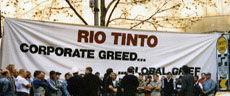
The Corporate Scumbags Tour of Sydney takes place Saturday, march 16. meet at Hyde Park, finish at First Fleet Park at 2pm.
|
|
|
|
************
Remember BHP's environmental disaster at Ok Tedi in Papua New Guinea and Esmereld's poisoning of the rivers of central Europe? Both of these were Australian companies which failed to implement overseas basic environmental standards which would have been legislative requirements in Australia.
A Bill to which aims to prevent a repeat of these disasters was introduced into the Senate by the Australian Democrats in August last year. It is now the subject of a public Inquiry by the Federal Joint Statutory Committee on Corporations and Securities.
The Corporate Code of Conduct Bill 2000 aims to apply environmental, employment, health and safety and human rights standards to the conduct outside Australia of Australian corporations with emaployees outside Australia.
The Bill requires corporations to report on their compliance with such standards, and provides for the enforcement of the standards.
There is ample evidence to suggest that voluntary codes of conduct for corporations are not effective, and that legislation is needed. The Bill addresses a regulatory vacuum which exists at national and international levels. The development over the last two decades of voluntary guidelines or codes at the international, industry and company level has proved ineffective.
Voluntary OECD Guidelines
The OECD Guidelines for Multinational Enterprises are the only internationally recognised standards for transnational corporations but are an example of the failure of self-regulation. They were devised in 1976 as a response to major scandals like the Lockheed bribery case in Japan.
The guidelines contained references to labour rights and the environment, but they were vague and essentially voluntary. There were no effective provisions for complaints or enforcement. Not until the furore over the OECD Multilateral Agreement on Investment (MAI) were the guidelines comprehensively reviewed. The new guidelines released this year have more detail in areas like the environment and corruption, but, at the insistence of corporations and some governments, are still not legally enforceable. Clearly their existence had no impact on the behaviour of BHP or Esmerelda.
Voluntary Industry Codes of Conduct
Industry codes of conduct also exist. However they suffer from fundamental weaknesses. Firstly, there is no requirement for companies to sign up to such codes. Esmerelda was not a signatory to the Australian Mining Industry Code of Environmental Management. Secondly there is no evidence that the Code is effective for those who sign it. There are no specific standards in the code and no penalties for non-compliance.
Voluntary Corporate Codes of Conduct
Some corporations have developed their own codes of conduct, and argue that these are a substitute for legal regulation. However these codes seldom have specific standards by with performance can be measured. In most cases implementation is not independently monitored. The codes can be more of a public relations exercise than a real guide to practical conduct for managers.
The example of the NIKE code of conduct illustrates this point.
In response to criticism of the employment conditions in the factories of its sub-contractors, Nike developed a code of conduct which contains commitments on human rights and workers rights. The code is supposed to apply in its sub-contracted manufacturing operations in Indonesia, China and Korea, and is monitored by PricewaterhouseCoopers.
A statement by Julianto, a worker at an Indonesian Nike factory who was brought to Australia by Community Aid abroad reveals the gap between the code and the practice.
He worked at the PT Nikomas Gemilang factory from 1997-April 2000, making outsoles for Nike shoes. Wages in the factory are $2 Australian per day. Twenty-three thousand workers work for 53-70 hours per week with unpaid overtime of several hours a day required to reach quotas. Workers are verbally abused and punished if they do not meet quotas. Accidents are very common.
Julianto and others formed a committee last year to discuss their working conditions began organising workers and approached management. They were threatened with physical violence if they continued to organise, and were then pressured to resign (Community Aid Abroad, 2000).
This personal account is supported by evidence from Dr Dara O'Rourke of MIT who in June this year accompanied and observed the monitoring process of PricewaterhouseCoopers in Nike Factories. He noted that management was notified of inspections well in advance, there was no opportunity to talk confidentially to workers and that some major issues were not included in the monitoring reports. The issues not included were hazardous chemical use and other serious health and safety problems, lack of freedom of association, violations of overtime laws, violations of wage laws and falsified time cards. The omission of these issues of course made the reports look more favourable. Dr O'Rourke recommended that monitoring be carried out by independent bodies experienced in human rights monitoring and that it must involve confidential interviews with workers (O'Rourke, 2000).
The development of codes of conduct can be of some benefit if they have specific objectives, if management takes them seriously and trains staff to implement them, if there are specific objectives and penalties for non-compliance. If there are no specific objectives, no independent monitoring of implementation and no penalties for failure then in many cases they will be ignored in practice and serve a public relations function only.
Regulation in Europe and the United States
The growing popular sentiment that the pendulum has swung too far in the direction of self-regulation has been reflected in legislative initiatives at the national level in Europe and the United States. These countries are the origin of most of the world's transnational investment. Therefore these initiatives indicate there is a significant international trend to regulation. Standards developed in Europe and the United States are likely to be adopted by international funding and insurance bodies. Therefore the development of similar standards and means of enforcing them in Australia will not place Australian companies at a disadvantage. On the contrary, it will enable them to comply with global best practice in these areas.
In January 1999 the European Parliament passed a Resolution on Standards for European Enterprises. The Resolution calls for legally binding requirements on enterprises to comply with international law on human rights and the environment in developing countries, and proposes that compliance be monitored by a panel of independent experts. The resolution also calls for funding for business from the EU to be conditional on compliance with human rights and environmental standards (European Parliament, 1999). This resolution faces a long and tortuous road through the EU institutions before it becomes law, but the fact that the process has begun is significant.
Similar legislation has been proposed by US Democratic Congress Representative Cynthia McKinney . This Bill requires US-based corporations to abide by a code of conduct with specific standards. Enforcement would be through preference in US government contracts and export assistance. Those harmed by non-compliance could also sue US companies in US courts (US Congress, 2000). This Bill has not yet received majority support, but its introduction is again significant.
The Corporate Code of Conduct Bill
The Corporate Code of Conduct Bill requires Australian-based companies with employees overseas to develop codes of conduct based on specific standards on the environment, human rights, labour rights and health and safety and to report to ASIC on these areas of conduct. There are legal penalties for non-compliance and the provision for civil actions through the Federal Court by those harmed by non-compliance. Thus it combines both an internal education process for companies in development of the code and the reporting process with penalties for non-compliance.
The Bill follows the precedents of two other pieces of Australian legislation which address the issue of extraterritoriality . These are the Criminal Code Amendment (Bribery of foreign Public Officials) Bill 1999 and the Criminal Code amendment (Slavery and Sexual Servitude) Bill 1999. Both of these laws enable the prosecution of Australian nationals for crimes committed outside Australian territory.
New Legislation for a New Government?
The Bill has been supported by submissions to the committee from the ACTU, the CFMEU and the AMWU, the Fairwear Campaign, Amnesty International, the Australian Council for Overseas Aid, the Public Interest Advocacy Centre and many other community organisations. However, without government support it will not pass this parliament.
Supporters of the Bill are urging the ALP and other opposition parties to use the information collected in the committee process to develop policy in the lead-up to the election. This could then form the basis of legislation in the context of a change of government. If you support such a policy, make your views known to your union, your party branch, MPs and shadow Ministers to help make sure it happens.
D.r Patricia Ranald is Principal Policy Officer at the Public Interest Advocacy Centre.

|
|
|
|
Dubbed nuclear Titanics a fleet of ships carrying nuclear waste is passing Australian shores. They've been compared to the Titanic by visiting UK based marine Pollution consultant Tim Deere Jones, because like the Titanic they are said to be unsinkable and they are not. What's more, they are sailing around Cape Horn and south of Tasmania dangerously close to iceberg drifts.
They are the UK registered Pacific Class PNTL fleet built and registered as dedicated irradiated nuclear fuel carriers. Registered owner Pacific Nuclear Transport Ltd is owned jointly by British and Japanese Nuclear utilities.
PNTL claim their ships are state of the art. And they were back in the early 1980s when most of them were built. They are carrying plutonium fuel and they are charting their course around Australia because no other government is crazy enough to let the ageing, substandard fleet and their lethal cargo anywhere near their coast. Not Indonesia, not Malaysia, not the Pacific Islands nor New Zealand. Only Australia.
In his report A Review of Aspects of the Marine Transport of Radioactive Materials, Jones warns that the vessels could sink and accidents could happen. If they do he says, there is no fail safe way of dealing with them.
The IMO has no training scheme for emergencies involving maritime transport of any class of radioactive materials
Jones points out that the relatively small PNTL vessels would be vulnerable in marine accidents. They are routed through heavy seas adjacent to the Roaring Forties, cyclones and tropical storms. And while they are said to withstand impact of 24,000 tonne vessel travelling at 15 knots, most merchant ships are bigger and faster travelling at up to 24 knots.
The fleet does boast a double hull around the cargo holds, but both bow and stern are single hulls.
Jones stresses that PTNL's claim the double hull is 'a ship within a ship' and therefore unsinkable, is just not true. He points to the recent sinking of chemical tanker Ievoli Sun in the English Channel in October last year. It was double hulled throughout and a much more modern vessel
Jones documents 19 incidents involving ships carrying nuclear waste in the last decade - one near miss, two collisions and five fires.
The average shipboard fire lasts 23 hours. American tests have shown that nuclear casks would only last two hours before being breached. In a worst case scenario, this leaves open the possibility of a plutonium cloud release endangering lives for thousands of kilometres.
"Shipments of intensely radioactive spent nuclear fuel and high level wastes and long lived radio toxic mixed oxide fuel (MOX) present unique risks to the marine environments they travel through and to the countries whose shores they pass," Jones says.
The effects of radiation exposure can be immediate or take a generation to manifest.
The United Nation report says: "Radiation by its very nature, is harmful to life. At low doses, it can start off only partially understood chains of events which lead to cancer or genetic damage. At high doses, it can kill cells, damage organs and cause rapid death. Radiation doses have to reach a certain level to produce acute injury - but not to cause cancer or genetic damage. In theory, at least, just the smallest doses can be sufficient. So no level of exposure to radiation can be described as safe."
Workers involved in a salvage operation after a Chernobyl-like disaster at sea for example would be exposed to lethal doses of radiation hundreds of times higher than the average received by nuclear power plant and nuclear waste workers.
The concern shared by both the MUA and Greenpeace is that Australia is not prepared for an accident at sea involving the growing number of nuclear shipments around its coastline.
The Jones report reveals major confusion and buck passing about which State or Commonwealth agency would take responsibility for an at-sea nuclear accident.
Greenpeace have been drawing public attention to the recent shipments sending a fleet of yachts into the path of the Pacific Pintail and the Pacific Sandpiper as they passed through the Tasman Sea.
At least 20 such shipments are planned in the next 10 years.
Sean Chaffer, National Shipping Campaign Coordinator for the Maritime Union of Australia, says the report has major concerns for seafarers who man tugs during salvage operations:
"We have experience with accidents at sea - accidents that they said would never happen," said Chaffer. "These shipments pose an unacceptable risk to our members, the marine environment and the Australian community."
Greenpeace Australia Pacific Nuclear Campaigner Stephen Campbell says, "The Australian Government is putting people's lives at risk in allowing the highly dangerous plutonium MOX fuel shipments past Australian shores. They are creating more nuclear waste shipments between France and Australia with plans for a new reactor at Lucas Heights."
Greenpeace yacht Tiama was in Sydney for the launch of the nationwide Greenpeace/MUA campaign and the Jones Report. It will next sail to Adelaide, Melbourne and Hobart.
It's a Waste
Meanwhile Greenpeace has successfully got France to ban unloading of Australian nuclear waste
ABC Radio reports the French court has banned a ship from unloading Australian nuclear waste at the northern French port of Cherbourg.
The Australian nuclear waste remains stuck on a ship in the French port of Cherbourg following a court decision.
The ship docked in France Friday, but after Greenpeace's intervention, the court, sitting in an emergency session, imposed an order banning COGEMA, a French firm specialising in re-processing nuclear material, from unloading the waste and taking it to its nearby plant at La Hague.
ABC reports COGEMA can appeal the decision, which was backed up with the threat of a 15,244 euro ($A28,237) fine to be imposed on each article of waste unloaded for each week it remained in France without authorisation.
COGEMA was also told to give Greenpeace copies of documents the group had requested relating to the shipment or face a daily fine of the same amount for every document not produced.
The court heard that the ship, Le Bougenais, was carrying 360 used nuclear fuel rods carried in five 20-tonne protective casks.
The shipment is the second of four deliveries COGEMA has contracted to take from the Australian Nuclear Science and Technology Organisation's (ANSTO) reactor at Lucas Heights in Sydney.
Some 308 rods were delivered between November 1999 and January 2000.
Under the contract between France and Australia, the waste is to be reprocessed in La Hague before being sent back to Australia for safe disposal.
But Greenpeace told the court that the fissile matter in the shipments, a form of 23 per cent enriched uranium, has never been dealt with at La Hague and that COGEMA does not have the technology to process it.
Greenpeace report the decision places the Australin government's contract to build anew reactor in jeopardy.
"This scandal reveals there are no workable plans for handling reactor nuclear waste," said Steve Campell, Greenpeace campaigner. "Both the Howard Government and COGEMA are either acting illegally or they're utterly incompetent."

|
|
|
Big Jim Larkin |
*********************
The Irish were in town last week, telling us about the startling success of their economy, and the size and prospects of the union movement there. They have over 50 per cent overall member rates and over 70 per cent in the public sector.
The turbulent history of modern Ireland is not absent from union history, with James Connolly an early important figure and a key participant in the Eater Rising in 1916.
Probably the most significant man in the development of the Irish unions before and after 1917, and shaped it especially between 1907 and 1914, organized during the bitter and ultimately unsuccessful Dublin lockout of 1913. however, was Big Jim Larkin. James Plunkett, playwright (Strumpet City, Big Jim, The Risen People) was one of his admirers and wrote the following in is honour.
"Jim Larkin and the Risen People"
And I say to my people's masters: Beware,
Beware of the thing that is coming, beware of the risen people
Who shall take what you would not give.
P�draic Pearse wrote those lines in April 1916, a time when the insurrection was imminent, yet the reference is broader than that. In the body of the poem the economic and social wrongs suffered by the poor and the destitute have their place beside the aspirations of nationalism. Back in the great Dublin lock-out of 1913, Pearse had come down strongly on the side of Jim Larkin and his ill-used followers, those outcasts referred to contemptuously by a largely antipathetic press as 'Larkin's rabble of carters and dockers'.
Ruth Dudley Edwards in her biography of Pearse quotes from his column 'From a Hermitage' in the Republican organ Irish Freedom, in October 1913 to establish his positive expression of support. He wrote:
I would like to put some of our well-fed citizens in the shoes of our hungry citizens, just for an experiment ... I would ask those who know that a man can live and thrive, can house, feed and educate a large family on a pound a week, to try the experiment themselves ... I am certain they will enjoy their poverty and their hunger ... they will write books on 'How to be Happy through Hungry'; when their children cry for more food they will smile; when the landlord calls for the rent they will embrace him; when their house falls upon them they will thank God; when policemen smash in their skulls they will kiss the chastening baton ...
And so on. The sarcasm is heavy-handed, but leaves us in no doubt about his sympathies.
Pearse had made his mind clear in an earlier article. In April of 1913 he had written:
My instinct is with the landless man against the lord of lands and with the breadless man against the master of millions. I hold it a most terrible sin that there should be breadless men in this city where great fortunes are made and enjoyed.
I calculated that one third of the people of Dublin are underfed; that had the children attending Irish primary schools are ill-nourished. Inspectors of the National Board will tell you that there is no use in visiting primary schools in Ireland after one or two in the afternoon; the children are too weak and drowsy with hunger to be capable of answering intelligently.
I suppose there are 20,000 families in Dublin in whose domestic economy milk and butter are all but unknown; black tea and dry bread are their staple articles of diet. There are many thousand fireless hearth places in Dublin on the bitterest days of winter. 20,000 families live in one-room tenements. It is common to find two or three families occupying the same room - and sometimes one of the families will have a lodger! There are tenement rooms in which over a dozen persons live, eat and sleep ...
That is the voice of P�draic Pearse. But it could be Larkin himself.
When Jim Larkin took up residence in Dublin in 1908, his reputation for making trouble had traveled before him. He was thirty-two years of age, a handsome man, tall, broad-shouldered, with a commanding appearance. He had spent the previous year in Belfast as a temporary organizer for the National Union of Dock Labourers whose headquarters was in Liverpool. His militant methods while there had alarmed not only the authorities and the employers of Belfast, but also the executive of the union back in Liverpool. He had used his new-found weapon of the sympathetic strike and his doctrine of 'tainted goods' with devastating effect, closing down job after job and even persuading the Belfast police to go on strike too, by convincing them that they should claim extra payment for the extra hours they had to spend on duty trying to keep order during the unprecedented succession of strikes.
In Belfast the press and denounced Larkin as either a socialist, an anarchist, or a syndicalist. When this had no effect, they labeled him as a Papist. In Dublin the abuse was shaped to suit its different audiences. There he was declared to be an Orange-man and the rumour was circulated that he was a son of Carey, the informer.
In fact he was the second son of impoverished Irish parents who had emigrated to Liverpool. He spent most of the first five years of his life with his grandparents in Newry. At the age of nine, however, he was back in Liverpool, a breadwinner now, working forty hours a week for a wage of 2s.6d. As a young adult he worked his passage to South America and when he returned to Liverpool he got a job on the docks as a foreman, but lost it when he came out on strike in sympathy with the men who worked under him. This led to his appointment as a temporary organizer for the National Union of Dock Labourers and so to his recruiting campaign on behalf of the trade union movement at first in Belfast and then in Dublin.
When he settled in Dublin in 1908 he found as distressing a picture as any revolutionary might look upon. The population of the city at that time was 305,000 people, a total from which Pembroke, Rathmines and Rathgar were excluded. Of these a total of 87,000 (almost one-third) were destitute. They lived in decaying tenements left behind by the rich of a vanished Georgian society which had gradually melted away in the years following the Act of Union.
When Larkin's aggressive methods of protest expanded to include an attack on the housing conditions it resulted in the setting up of a Housing Inquiry in 1913. The official report of the Inquiry divided the houses into three categories: (1) houses which appeared to be structurally sound; (2) houses so decayed as to be on the borderline of being unfit for human habitation; (3) houses unfit for human habitation and incapable of being rendered fit for human habitation.
The structurally sound houses accommodated 27,000 people. The borderline houses held 37,000 people and in the houses declared by the Commission to be absolutely unfit for habitation 23,000 lived. Witnesses summoned by the Commission testified to the living conditions in the houses. One described seeing a room sixteen feet square occupied by the two parents and their seven children. They slept on the floor on which (the witness reported) there was not enough straw to accommodate a cat, and no covering of any kind whatever. The children were poorly clad; one wrapped in a rag of some kind and his only other clothing a very dirty loin cloth. There was no furniture; a zinc bucket, a can, a few mugs or jam jars for drinking. The rent was two shillings and three pence weekly; wages over some weeks four shills and sixpence, with a maximum of twelve shillings in the week.
A photographic survey of the tenements was commissioned by Dublin Corporation for submission to the Inquiry and these remain to add visual testimony to the grim living conditions.
However, no one who grew up in Dublin through the 1920s and 1930s and 1940s of the present century will need photographic proof because during those years many areas of the city continued in the same state of decrepitude. They will remember tottering tenements with broken or non-existent hall doors under shattered fan lights; rickety stairs and foul hallways exhaling malodorous breath of woodrot, inadequate hygiene, overcrowded human bodies, and filth which poverty had little or no means of controlling.
A spokesman for the employers admitted freely that the living conditions of the families of unskilled and casual workers were appalling but tried to excuse the part played by low wages in bringing it about. Explaining the situation as he (and, presumably, the other employers) saw it, he wrote:
While it is impossible to withhold sympathy from classes so depressed as these slum-dwellers of Dublin are, it cannot be overlooked that the very nature of their mode of living tends to reduce their value in the labour market.
One point upon which witness after witness insisted (in the course of the Inquiry) was the physical deterioration of men who found their way into these terrible hovels. Once drawn into the abyss, they speedily lose not merely their sense of self-respect but their capacity for sustained exertion. At the same time the thought of all that is implied in this vicious housing system in the way of demoralization and decadence of physical powers should make us wary of playing the role of critic to employers who have to use this damaged material.
He speaks of 'the men who find their way into these terrible hovels' as though it was their personal choice. It was not. Inadequate wages or complete lack of employment left them with no option but life in the hovels. And, because of their physical strength and health have been impaired by hunger and unhygienic living conditions he suggests it justifies paying them still lower wages, a recourse which can only leave them less able as labourers and more damaged than ever.
The society Jim Larkin came to scrutinize in angry detail was rigidly class-bound from the remote aristocratic stratum to the professional business classes, to the traders and shopkeepers down to the aristocracy of labour which consisted of the skilled craftsmen and artisans, most of whom could cast their history back to the old guilds with their coat of arms, their mottoes, their badges of trade, their colourful medieval regalia and customs. All of these had evolved procedures for regulating wage rates and control of the internal administration of their trades.
At the bottom of all were the unskilled and casual labourers. They were looked down on by the craftsmen. The middle and upper classes were barely conscious of their existence. No trade union had succeeded in creating an effective organization for them.
Larkin found this lowest of the classes apathetic and resigned to the hopelessness of their lot. He took on the task of instilling spirit and confidence in them through speeches which demonstrated his supreme skills as a demagogue, and impassioned exhortations in the Irish Worker which he began to publish in 1911. An example of the many was this:
At present you spend your lives in sordid labour, your abode in filthy slums; your children hunger and your masters say your slavery must endure forever. If you would come out of bondage you yourself must forge the weapons and fight the grim battle.
In fact, the rapid growth of the Irish Worker was a measure of his impact. In June 1911 it sold 26,000 copies; in July this became 66,500; in August it grew to 74,750 and in September it was 94,994.
His style was colourful and sometimes evangelical. At a Board of Trade inquiry into the endless outbreak of industrial unrest he warned those who were the root cause of the poverty and the suffering with the words: 'Christ will not be crucified any longer in Dublin by these men.'
Daniel Corkery noted his frequent recourse to poetry when addressing his impoverished audiences. He wrote about Larkin:
I took him to be a man of ideas, some of them wrong but most of them right - or at least right according to my lights ... I regarded him as one earnest to a fault, for I never heard him speak to the class for which he stood that he did not half offend them by dwelling on the failings which kept them powerless and timid ... By dint of experience he had slept in every workhouse from Land's End to John-o'-Groats; by dint of reading it was his custom to quote poetry as freely as I would myself if I had more courage ...
Another task confronting Larkin was to bring the artisans and the craft workers to the assistance of the unskilled and the casuals. He emphasised the element of brotherhood which should unite those who worked for the rulers of a capitalist society. It was a slow process to erode the skilled men's snobbery and sense of superiority over the unskilled and often illiterate denizens of the sums, but he moved matters slowly along the road. 'The great are not great' he told his followers time after time. 'The great only appear because you are on your knees. Rise up.'
Another task was to arouse awareness throughout society, especially the well-to-do and the intellectuals, of the direness of the plight of the poor and the destitute. Society, by and large seemed to be unaware of it, probably because a rigid class structure insulated them from brushing shoulders with it. Larkin's task was to implant and encourage the growth of a new social conscience. He was no mere reformer - he was a revolutionary. He described his campaign as his 'divine mission of discontent' and declared that his objective was to put on each poor family's table not only a loaf, but a vase of flowers as well.
So, from 1908 to 1913 the business life of the city staggered from crisis to crisis with thousands of unskilled workers galvanized into unprecedented acts of revolt and the employers rejecting any form of negotiation and fighting back, at first individually and then with determined solidarity through their newly formed Employers' Federation under the leadership of William Martin Murphy. That was in 1911. Matters waited to some to a head for two years. Then, on the morning of 18 August 1913, a letter appeared in William Martin Murphy's paper, the Irish Independent, over the signature of C.W. Gordon, acting secretary to the Dublin United Tramway Company (which was also controlled by William Martin Murphy) which read in part:
From the numerous applications to the company's officials by casual labourers seeking work, my directors believe there is a greater dearth of employment for this class of labour than usual. With a view to relieving to some extent the distress which is attendant on this condition of affairs, the company are about to start the relaying of some of the tramway lines they had not intended to relay until next year ...
The letter went on to invite applications, but warned that since the directors believed that much of the distress could be attributed to the disruptive tactics of the Irish Transport and General Workers' Union, members of that union would not be considered for employment.
To the middle-class reader at the breakfast table or on his way to the office the letter was an admirable demonstration of the Christian concern of the Dublin employers and their solicitude for the less fortunate members of the community.
But for Jim Larkin, the thirty-seven year old agitator and trade union leader, it was a declaration that confrontation on a massive and organized scale was imminent. Twelve months before he had served demands on the Tramway Company which had still not been replied to, while a few days previously the dispatch boys in the Irish Independent newspapers had been dismissed in a body because they had refused to leave the Transport Union.
The letter confirmed his suspicion already expressed: that William Martin Murphy, in expectation of a strike in the Tramway Company, was preparing for it by recruiting a double staff so that when the union men downed tools there would be a body of non-union employees ready to take their places.
On 21 August the employees in the Parcels Department of the Tramway Company were dismissed because they continued to be members of Larkin's Union. On 22 August the tram conductors and drivers were warned that if they went on strike for the reinstatement of their colleagues it could not last a single day, because the company had staff in readiness to take over their duties and also had guarantees of ample protection from the government and the forces of the Crown. Despite this warning the tram-men decided to do battle in defence of their colleagues and at ten o'clock on the morning of 25 August they left their cars in the street. The issue was joined.
That night Larkin addressed a massive meeting in Beresford Place. Scabs were already running the trams and feeling was growing high. Larkin spoke of the onslaught the employers had planned and of the fact that Lord Aberdeen had promised Murphy not only the police but the military as well. He advised his listeners to arm for their own protection. 'If Carson can arm his braves up in the North', he announced, 'we can too'. His resulting arrest on a charge of incitement put Dublin in a fever of protest. Riots broke out in various parts of the city and pitched battles took place with the police when the people stoned the trams and attempted at various points to dig up the tramlines. The military were called out.
Meanwhile the authorities, torn between the fury of the people at Larkin's arrest and his undoubted capacity for doing further mischief if he was let out, decided to risk releasing him on bail, probably feeling that the situation could hardly deteriorate much further. Larkin's first move was to announce that he would address a meeting in Sackville Street on the following Sunday. When the meeting was proclaimed by Magistrate Swift, Larkin assured his followers that it would be held. When Sunday came Sackville Street was packed with expectant citizens and heavily posted with Dublin Metropolitan Police and hundreds of extra police drafted in from the provinces.
There was no sign of Larkin until an elderly and apparently infirm man appeared on the balcony of the Imperial Hotel. He wore a beard and was dressed in a frock coat. He surveyed the crowd below for a while, then removed the beard and began to speak. It was Jim Larkin. Within a couple of minutes he was seized and arrested by the police. Then, as he was being led away, there began a series of baton charges of such violence that reports were carried in the press all over Europe and the United States. At home and in Britain eye witnesses of eminence and importance testified to scenes of unprecedented brutality.
However, the employers remained determined on a fight to the finish. There were now 400 of them in the Employers' Federation and they united to issue a form to each of their employees with an instruction to sign it. The form declared that the signatory would leave the Irish Transport and General Workers Union if he or she was a member or - if not a member - that he or she undertook never to become a member.
At this point Larkin's campaigning proved to have been successful. Not only did the Larkinites refuse to sign the form but trade unionists belonging to thirty-two other trade unions took up the challenge and also refused to sign. These included the craft workers' unions. The employers stuck to their guns and shut their doors all over the city. A huge lock-out was now in progress and thousands of workers and their families faced unemployment and hunger.
In spite of attempts at mediation, the lock-out lasted for over six months. Throughout its duration Larkin made a superhuman effort to hold the workers together. James Connolly was summoned from Belfast to add his expertise to the effort and night after night meetings were held at Beresford Place, which became known among the strikers as 'the old spot by the river'. Where eloquence alone might have lost its effect Larkin's unerring instinct for the dramatic prompted him to gestures which lifted up wavering spirits and fired their determination. One of the more spectacular occurred when the workers of Britain subscribed to create a relief fund. Larkin decided to show the workers something more inspiring than a subscription list. He had the food delivered to Dublin on a food ship which was hired especially, because he knew that the sign of a food ship steaming up the river with relief supplies from their fellow workers in Britain would be a sight still to be talked about when the food itself had been eaten and forgotten.
The lock-out dragged on and gradually petered out. Men either got their jobs back without being made to sign the form, or signed it in the knowledge that it had become an empty form of words which the employers were no longer anxious to enforce.
Yet when the clamour died away, the mists lifted to reveal what had been achieved. A whole forgotten class had emerged from obscurity into a society which was conscious of a new concept of their rights and dignity. The leading voices of the liberals, the intellectuals, the patriots, the artists and the writers had spoken out almost unanimously in support of their cause. Numbered among them were: P�draic Pearse, W.P. Ryan, Sheehy-Skeffington, Handel Booth, Tom Clarke, Ernie O'Malley, Keir Hardie, James Stephens, W.B. Yeats, G.K. Chesterton.
Maud Gonne McBride had written in their defence. Constance Markiewicz had worked in the food kitchens of Liberty Hall to cook for them and feed them. Sir William Orpen the painter and master of portraiture, was a regular visitor to Liberty Hall throughout the six months and, in his work of reminiscences, Stories of Old Ireland and Myself describes seeing Sheehy-Skeffington returning to the hall with his clothes in tatters after an attack on him by fanatics when he was bringing the children of strikers to the quays to be brought to homes in Britain where people would feed and look after them.
And George Russell (A.E.) wrote his letter which he headed To the Masters of Dublin which has become a classic of powerful and precisely moulded invective in which every sentence strikes straight into the center of its target.
There were many many more who voiced their sympathy and compassion. In doing so they revealed that the seeds of a new concept of social responsibility had been planted in the conscience of the nation.
Others those who were inspired after meeting Larkin and whose memories of him are collected in Trade Union Century edited by Donald Nevin (Mercier Press in Association with the Irish Congress of Trade Unions and RTE, 1994) were Charlie Chaplin, Ralph Chaplin (author of Solidarity Forever), Keir Hardie, and other heroes in the Irish pantheon such as James Connolly, Constance Markievicz, Sean O'Faolain, Liam O'Flaherty and P�draic Pearse.

|
|
|
Ian West |
****************
This "Alert" is intended to provide you with a snapshot of how Parliamentary laws and Government initiatives are progressing. It will contain discussion papers, green & white papers, legislation and initiatives. It's not an exhaustive list; rather it has been compiled using the Notices of Motions Paper, and also from the Ministers' offices themselves. If you have any queries about where something is up to contact my office and I'll assist in following up the issue.
The "alert" will come in three relevant sections; the first section will focus on what usually occurs before legislative reforms or laws are introduced to the Parliament (eg. includes Green/White/Discussion Papers/Exposure Bills/Working Groups); the second section will look at legislation mooted of currently before the House; and the third will look at Government initiatives and announcements.
Bob Carr Premier; Minister for the Arts; Citizenship
Green/White/Discussion Papers - "Private Financing of Public Infrastructure" submissions closed on 28th February 2001. Further information can be accessed on http://www.nsw.gov.au/wwg/ I recommend all people look at this document because of its many implications. The Premier has identified the need for the community and unions to be involved in the processes and working groups that this Paper gives rise to.
Initiatives - Mid Term Statement will be held 25th March at 11.00am at Joan Sutherland Performing Arts Centre, 597 High Street, Penrith. The Premier will report on the Government's progress in finding new solutions and responding to the needs of the community.
Andrew Refshauge Deputy Premier, Minister for Urban Affairs & Planning; Housing; Aboriginal Affairs
Green/White/Discussion Papers - State and Local Planning will be streamlined under the Minister's "Plan First" White Paper released on 6/3/01. State Plan will be one document, which encompasses the planning requirements of all Government Agencies. It will include policies on water quality, air pollution, transport and wetlands protection. Regional Plan will provide a blueprint for the sustainable development of each of the regions, and cover the regional planning requirements of Government agencies. Local Plan will for the first time be a single plan for each local government area, containing all the planning requirements needed by an individual landowner.
The "Plan First" White Paper is available from all DUAP offices, or by phoning 1800 806 361, or website at http://www.duap.nsw.gov.au/planfirst
Michael Egan Treasurer; Minister for State & Regional Development; Vice President of the Executive Council
Green/White/Discussion Papers - the "Private financing of Public Infrastructure" document can be accessed as mentioned above. We'll be hearing more about this over the coming months.
Legislation - State Budget due on 29th May 2001.
Initiatives - The Treasurer announced during Question Time on 8-03-01, that the upcoming Budget will include the abolition of taxes under the intergovernmental agreement, comprising the abolition of financial institutions duty at a cost to revenue of $634 million per year and the abolition of stamp duties on marketable securities at a cost of $425 million per year. Additionally there will be a further $150 million in tax cuts in the coming Budget, a "responsible increase in spending" and it will be the fifth Carr Labor Budget to be in surplus.
Bob Debus Attorney General, Emergency, Minister for Environment; Emergency Services; Assisting Premier on the Arts
Legislation
Legal profession reforms: the Minister recently announced amendments to the Legal Profession Act that will require bankrupt barristers and solicitors to prove they are fit to continue practising the law or be struck off.
Initiatives:
Nature Conservation Trust
The Carr Government has added 1.4 million ha. of high conservation value land to the national parks system in NSW in 6 years. The Minister has recognised the need for appropriate mechanisms to protect private land that has high conservation value, and has introduced legislation to establish the NSW Nature Conservation Trust, an independent, Non-Government body designed to facilitate conservation of lands outside the formal reserve system.
Environment Trust Grants
The Minister recently announced over $7.2 million in Environment Trust grants for 142 projects state-wide to help improve and protect our environment. The grants are for major state-wide and regional environmental challenges, as well as local environmental problems. $3 million has been granted under the Abandoned Mines Program to rehabilitate derelict mine sites. $1.7 million will go to community organisations and schools across NSW. The Government has provided more than $1.9 million to 10 research projects including $256,000 for the University of Western Sydney (Hawkesbury) to investigate ways of managing chemical and pesticide use by non-English speaking farmers.
Record funding for our emergency services
$469 million is being spent this financial year to ensure the NSW Fire Brigades, Rural Fire Service and the SES are even better equipped to protect and assist the community during emergencies. It's $161 million more than the Coalition provided in its last budget.
Harry Woods Minister for Local Government; Regional Development & Rural Affairs
Submissions sought - The Minister is contemplating a "Local Government Sin Bin" option to help deal with disruptive councillors. Public comment is sought by the Minister for Local Government on options to deal with disruptive councillors. In the past year 8 local councils were brought to the attention of the Dept of Local Govt. for so-called councillor misbehaviour. Submissions and comments on Councillor Behaviour Options can be sent to "The Department of Local Government, Locked Bag 1500, BANKSTOWN NSW 2200."
Local Government website is http://www.dlg.nsw.gov.au and for Regional Development it's http://business.nsw.gov.au
Sandra Nori Minister for Small Business; Tourism
Green/White/Discussion Papers/Workshops - The Minister has announced a series of workshops throughout March to help formulate a comprehensive plan for the state in Nature Tourism. The workshops will be discussing key issues, challenges and opportunities in developing sustainable practices in bushwalking, camping, cross country skiing and wildlife viewing. NSW has 500 national parks and nature reserves, 4 world heritage areas, 3 marine parks and 8 aquatic reserves. The workshops would address priority issues such as nature tourism products and experiences; sustainable access; infrastructure development such as transport and accommodation; and training.
Initiatives - The Minister also announced a new international tourism campaign called "Feel Free," which will target key Asia markets such as Singapore, Hong Kong and China. It is part of the Government's post-Olympic strategy to increase investment in NSW.
To go to Tourism website: www.tourism.nsw.gov.au and for Small Business: www.smallbiz.nsw.gov.au
Carmel Tebbutt Minister for Juvenile Justice, Assisting Premier on Youth, & Assisting for Environment
Initiatives - The Minister and the Department are discussing with the Public Service Association (PSA), ways in which the ratio of Staff to Detainees in Youth Detention Centres can be increased.
Information, publications and research papers, as well as links to other Departments and organisations can be accessed at the following address. Juvenile Justice website: http://www.djj.nsw.gov.au
John Watkins Minister for Fair Trading; Corrective Services; Sport & Recreation
John Watkins has recently assumed responsibility for the Corrective Services portfolio.
Green/White/Discussion Papers/Exposure Bills/Working Groups - The Minister released an exposure bill aimed at overhauling NSW home-building laws. Reforms include giving consumers more information about tradespersons' past Fair Trading records. The Fair Trading Director General will be given power to cancel and suspend licences. Building licensees will be required to continue educating themselves each year. The Fair Trading Tribunal Building Division will cap cases to under $500,000 to stop large developers clogging the tribunal.
Legislation - Trade Measurement Amendment Bill
On 6-03-01, John Watkins introduced new laws to help ensure consumers get everything they pay for when they buy groceries and other products. Under the Bill consumers must only be charged on a net weight basis - that is, without any packaging included in the stated weight or price. Mr Watkins said. "Traders who include packaging in the price are clearly ripping off consumers." The new law also applies to petrol pumps, alcohol dispensers, weighbridges, industrial scales, firewood and even rubbish dumped at the tip. A Supermarket Working Group has been formed - consisting of Fair Trading, the Australian Retailers Association and supermarket chains - to address this problem. The NSW legal change is part of a nationwide approach. All other Australian fair trading jurisdictions, excluding WA, are passing similar trade measurement laws.
Initiatives - The Minister officially opened the Hills District Netball Association's Netball Centre on 24th February. The new indoor centre will host competitions, and provide elite and local athlete training and coaching. The Hills district has 3,500 registered netballers. Watkins' Department provided assistance of $800,000.
The Minister also got agreement from the Banks about gaining access to sensitive commercial information to help produce an accurate figure of the nation's over-commitment on credit. The Victorian and NSW fair trading ministers would look at assessment criteria, default rates on loans, and how credit limit increases are assessed in a bid to help people stop getting over their heads in debt. Australians currently owe about $70 billion in personal debt, with $17.4 billion of that on credit cards.
Duty branch information relevant to John Watkins' Sport & Rec portfolio includes $46,657 funding for the Ku-Ring-Gai electorate for sunprotection shades for greens at St Ives Bowling & Recreation Club, fixed playground equipment at Gordon East primary school and toilet with upgraded access ramp and car parking space at Ku-Ring-Gai Council. In Hawkesbury, funding totalled $46,481 on ski boat for disabled, upgraded playground for Hornsby Council, 3 cricket practice nets for Galston-Glenorie JCC, half court basketball court for Hawkesbury Council, and children's safety enclosure for Annangrove Park. In The Hills, funding totalled $46,185 for recreation facilities for Baulkham Hills Council, upgraded playground for Hornsby Council, and light towers for evening training at Castle Hill United Soccer Club.
Further info Sport & Recreation: www.dsr.nsw.gov.au & Fair Trading: www.fairtrading.nsw.gov.
by by Nicholas Guyatt (Pluto Press)
In the first months of 1999, commentators in the US began to turn their eyes towards another American century, grounding their vision in an upbeat assessment of the present and recent past. In the years since Henry Luce's 1941 essay, the United States had faced down the forces of totalitarianism and communism, winning the Cold War and still leaving time for a decade of neoliberal 'globalisation' - a process which consolidated the US victory across the globe. Bill Clinton's 1999 State of the Union address suggested that the US had made great progress towards preparing the ground for 'the next American century'; other Americans shared his optimism, seeing few obstacles to US domination of another hundred years of world history.
As some of the more influential US commentators prepared their millennial musings at year's end, however, they were rudely interrupted by an unexpected source of protest. Earlier in the year, the World Trade Organisation (WTO), the umbrella organizations for international trade negotiations, had decided to begin a new round of talks in Seattle. The city happily accepted the challenge of hosting the conference, but various dissenting groups announced throughout the year that they would make Seattle the focus of protests against the WTO. These groups represented a wide variety of interests. Environmentalists saw the WTO as a leading force behind global climate change and the circumvention of environmental standards, especially in the developing world. Labour advocates charged the WTO with exploiting low-wage workers in other countries. US unions carried their personal grievance that the low-wage economies encouraged by the WTO in developing countries had taken manufacturing jobs from American workers. Development groups protested over the issues of Third World debt and system global poverty, accusing WTO of encouraging free trade even as the gap between poorer and richer countries widened further.
These groups had many things in common. They were mostly based at the grassroots level, and depended on local organisers, often brought together by innovative technologies like the Internet. They were well-organised, and understood both the issues before them and the need to build coalitions (and public support) to effect change. Most profoundly, however, they represented ideas and values which were largely excluded from the political mainstream in the US, Europe and much of the rest of the world. Amidst the talk of the free-market revolution, or its 'centrist' variant, the so-called 'third way', there was virtually no room in political debate for these emphases on the protection of the global environment, the need for good working conditions and a liveable wage, and the problem of global economic inequality. Although the WTO was merely the forum in which; politicians and business leaders would discuss a new round of trade liberalisation, these protesting groups correctly realised that the Seattle meeting would gather together many of those primarily responsible for the plant's most pressing inequities. Even before the WTO delegates began to arrive, the press billed the meeting as 'the battle in Seattle', a rare moment in which the leaders of the global economy would come face to face with organised and intelligent opposition.
To the apparent surprise of the Seattle officials and the Clinton administration, which had organised the WTO convention, the protesters disrupted proceedings from eh first day of the meeting. On Tuesday 30 November, tens of thousands turned out to march in the streets, to form human chains around buildings at which WTO events were scheduled to take place, and to register their complaints about the WTO and the injustices of the international economy. WTO delegates were marooned in their hotel rooms, unable to move freely around streets filled with protesters. The police, realising that the opening day of the conference was descending into chaos, began to employ more draconian tactics against the vast crowds. Unarmed protesters were dispersed with tear gas, concussion grenades and even rubber bullets. The police fought running battles through the streets, struggling to overturn the vast numbers of marchers, who simply regrouped after each gas attack and began to march once more. The scenes of protest and repression were beamed throughout the US and around the world, presenting a striking contrast to the generally upbeat tone of the Clinton administration on economic issues. In the midst of a spectacular American economic boom, an estimated 35,000 protesters gathered in Seattle to reject the president's line on global economy.
The president himself made a typically contradictory contribution to the meeting. Arriving late on Tuesday night, the president prepared for his address the next day by instructing the Seattle authorities to impose martial law, and to seal off an enormous area of downtown Seattle from anyone without WTO credentials. With the National Guard instructed to take up positions on Seattle's streets, the president travelled to a lunch meeting with the major international delegates and spoke of his sympathy for the protesters he had just excluded. Condemning the small minority (estimated in the dozens by virtually all observers) who had committed acts of violence, Clinton went on, inexplicably, to praise the thousands of others who had choked on the tear gas of the police the previous day:
But I'm glad the others showed up, because they represent millions of people who are now asking questions about whether this enterprise in fact will take us all where we want to go. And we ought to welcome their questions, and be prepared to give an answer, because if we cannot create an interconnected global economy that is increasing prosperity and genuine opportunity for people everywhere, then all of our political initiatives are going to be less successful.
Clinton, the master politician, may well have taken this line in the hope of advancing his vice-president's cause with the US labour unions, especially with a view toward 2000 presidential election. Moreover, his tolerance of the protesters was obviously made easier by the careful exclusion of those same protesters from the city on the day of his speech. However, the angry response of some delegates and business leaders to his comments suggest that his modest remarks had worried his audience of governmental officials and corporate representative. Given the complete breakdown of relations between the angry crowd and the angry WTO delegates, was there any hope for a reconciliation of the two? And if this preliminary meeting had aroused such passionate opposition and such large crowds, did Seattle represent a precedent for the expression of popular opinion through direct action, rather than via a political system largely funded and controlled by elites?
The story of what happened in Seattle is worthy of closer examination, not least because many of the commentators we met in the last chapter have tried to take over this story for themselves, or to frame the issues as best they can to alienate the protesters from the millions of Americans who saw the demonstrations on television or in the newspapers. Jeffrey Garten, writing in Business Week, actually warned his readers in advance of the conference that Seattle 'is likely to be the scene of a big test for global capitalism'. With impressive inventive skills, Garten depicted the forces of global capitalism as weak and threatened, and portrayed the non-governmental organizations (NGOs) and protest groups as the oppressive force in the battle for public opinion:
While governments and chief executives bore the public and the media with sterile abstractions about free markets, NGOs are sending more nuanced messages sensitive to the anxieties of local communities around the world. At the same time, they are preparing sophisticated strategies to influence television networks, newspapers, and magazines. There is plenty of evidence of NGOs growing clout. In recent years, they have changed the policies of global corporations such as Nike (over treatment of workers abroad), Monsanto (over genetically engineered products), and Royal Dutch Shell (over environmental issues) ... If Washington and Corporate America don't move decisively, NGOs could dominate public opinion on global trade and finance.
To many readers, these examples of NGO pressure might seem positive contributions, a proper public scrutiny of corporate interests. Fro Garten, however, these modest achievements portended the broader submission of business to public pressure, an outcome which led to the hysterical suggestion that NGOs might find was to influence an international media which is securely in the hands of some of the world's largest corporations. Even the readers of Business Week found Garten's warning hard to handle, complaining in subsequent correspondence that his 'surreal' vision merely proved that, rather than 'open world economy', the 'one thing the world needs is open political processes.' Garten's article was useful, however, in showing the anxiety of financial elites about the kinds of questions raised by protests in Seattle, and their effects on a broader base of public opinion.
Fareed Zakaria, ministering tot eh readers of Newsweek, acknowledged after the protests that Seattle had been a 'fiasco', and 'unmitigated disaster'. However, his editorial defended the international economy and the current mechanism of global trade in equal measure. Conveniently ignoring the fact that inequalities between rich and poor nations have increased massively in recent decades, Zakaria suggested that the 'downtrodden' people of the Third World were clamouring for the WTO and its many instruments of trade liberalisation. Moreover, Zakaria tried to indemnify the WTO from any responsibility for implementing minimum standards on labour conditions, wages and environmental concerns. 'There are other methods, treaties and organizations aimed at pursuing these worthwhile goals', he announced sophistically, as if trade and social conditions were mutually exclusive. The final weapon in his arsenal was to accuse the protesters of hypocrisy in their complaints against the WTO:
The demonstrators claimed to be acting in the name of democracy .... But, of course, not one of these organizations is in any way accountable to anyone. Most of them represent small and narrow interests that have been unable to build mainstream support for their demands. The truth is that labour unions, environmental activists and other activists are trying to impose regulations through the WTO that they were unable to persuade the United States Congress to accept.
Apart from the obvious hollowness of this charge, given the participatory and extremely democratic structure of many of the protesting organizations, there is something rather absurd about Zakaria's pique. Hailing the WTO's commitment to democracy just weeks after it voted to admit China as a full member seems rather hollow; as does the shrill boast that protesters cannot obtain the backing of a united States Congress which was, at the end of the twentieth century, more dependent on lobbyists, campaign finance and corporate influence than at any other time in American history. Instead of questioning the efficacy and reliability of these putatively democratic processes in American life, Zakaria simply smeared the protesters who'd chosen to deliver their message in Seattle rather than in Washington, DC.
Predictably, the most irate commentator on Seattle was Thomas L Friedman, whose own bible of globalisation, The Lexus and the Olive Tree, had hardly predicted this kind of popular uprising in the US. Friedman actually needed two editorial columns in the New York Times fully to expectorate his bile at the protesters - 'Senseless in Seattle', and the sequel, 'Senseless in Seattle II'. Friedman could hardly contain his anger: 'Is there anything more ridiculous in the news today than the protests against the World Trade Organisation in Seattle? I doubt it.' Friedman's tactics were rather different from those of Garten and Zakaria, however: his telling of the Seattle story cast the protesters as late-twentieth-century Luddites, opposing neither global inequality nor labour exploitation, but the idea of trade between nations itself. This enabled Friedman to reach some odd conclusion about the protesters' motives and methods:
What's crazy is that the protesters want the WTO to become precisely what they accuse if of already being - a global government. They want it to set more rules - their rules, which would impose our labor and environmental standards on everyone else. I'm for such higher standards, and over time the WTO may be a vehicle to enforce them, but it's not the main vehicle to achieve them.
Since Friedman refused to imagine a 'globalised' world in which standards of pay, labour conditions and environmental impact are regulated and improved, he couldn't recognise the protesters as truly international in their vision; nor could he understand why they would target the WTO, the body which supposedly regulates global trade, if the notion of regulation in and of itself has been demonised. His editorial pieces were notable for their complete inability to accept the protesters' terms, or to consider their mere presence in Seattle as valid. For Friedman (as for Garten and Zakaria), the job of the WTO is to destroy environmental or social standards which bar free movement of goods and money, even if the consequence is a rush to the basement by governments and employers, eager to produce the cheapest products regardless of their effects on workers and on the environment.
Friedman's initial editorial, written in the heat of his anger, seemed unusually intemperate and rude. In his follow-up, he acknowledged that his 'environmentalist allies' (translation: former environmentalists who now work for corporations) had suggested that 'my criticism of the protesters in Seattle was too broad-brush'. Rather like Bill Clinton, Friedman offered the vague idea that the WTO could be 'opened up', although he undercut any radical implication here by simply noting that it had 'no need' to be secretive in its deliberations. Friedman's willingness to open the WTO to scrutiny was tied to a crucial companion tactic, concerning the agenda of the protesters in Seattle. The protesters had argued that standards on labour, wages and the environment should be guaranteed internationally. Friedman, on the other hand, contended that the customer should determine such things - if customers were sufficiently vexed by low wages abroad, or by the environmental impact of a corporation's activities, they should organise ad hoc protests and change policy by their actions at the cash register. In the meantime, free trade would continue to define the global economy and environment, with only intermittent interruption from the occasional cause celebre of consumer groups.
Many objections to Friedman's solution come to mind. In the first place, corporations hardly publicise many of their abuses or cost-cutting exercises, and the notion that 'consumers' will learn of these abuses from a corporate-controlled media seems optimistic at best. The television and newspaper coverage of the Seattle events frequently suggested that the protesters were enemies of any kind of trade, and that a high proportion were engaged in violent activities during the protests. Conversely, journalists were often uncritical of the Seattle police department, even after pictures of tear-gassing and the firing of rubber bullets had reached the newsrooms. In the midst of the street protests and the 'riot-control' measures, Lou Waters of CNN concluded an interview with a Seattle police spokesperson with a cheerful sign-off: 'Good luck to you out there today.' Given this kind of soft-pedalling, it seems fanciful to suggest that corporations or governments are overly worried that the media will amplify the message of Seattle's protests to a wider public.
Moreover, 'consumers' in the richest countries posses far more disposal income than citizens of poorer countries, and this wealth entitles them to a much greater influence in any market-based regulatory system. Regulation by consumer would amount not to democratic control, but to the foundation of a one-dollar, one-vote principle at the heart of the world's political system. Should the fate of the majority of the world's people depend entirely on the consumer preferences of a small minority in Western countries? According to Friedman, undoubtedly. Finally, the impact of industry and energy consumption on the global environment is measured in climatic changes over decades, even centuries. Although most scientific experts agree that the planet is headed towards disastrous climate change, the effects of this change will be overlooked by government and individuals unless they are compelled to take a long view. Many consumer decisions are extremely short-term and fickle, and the notion of basing environmental policy on such immediate concerns as cheap fuel prices seems extraordinarily short-sighted as one views the environmental problem from a broader perspective.
The idea of regulation, then, seems absolutely necessary to combat the environmental and human disasters which loom in the coming century. Friedman, however, anticipated this thinking in his editorial, and reanimated an old demon to forestall these ideas:
Too many unions and activists want the quick fix for globalisation: just throw up some walls and tell everyone else how to live. There was a country that tried that. It guaranteed everyone's job, maintained a protected market and told everyone else how to live. It was called the Soviet Union. Didn't work out so well. In the end it probably did more damage to its environment and workers than any country in history.
Behind the protests in Seattle, then, lay a simple choice: rampant globalisation on Friedman's model, or a submission to regulation which could only lead back towards communism and Soviet tyranny. In Garten's warnings about the power of NGOs and popular protest, Zakaria's arguments that protesters were undemocratic because they couldn't afford to lobby the US Congress, and Friedman's explicit incarnation of the Red menace, the same message was apparent: at the end of the twentieth century, the only alternative to unfettered capitalism, with all its admitted faults and inequities, was a communist terror; and so there was really no alternative at all.
Although we should refrain from passing definitive judgement on the six decades since Luce's 'American Century', we can hardly avoid observing that the battle against communism has been a constant theme in American politics throughout this period; and that political debate even today, more than a decade after the Soviet Union's collapse, is conditioned by the supposed threat of socialism or communism. Although the US government has intervened heavily in its economy throughout this period, particularly in the support of military industries and through corporate tax relief more generally, the suggestion that the US should regulate the economy more closely to guarantee minimum standards of health, education and income has been anathema to generations of politicians and ideologues. Moreover, the spread of neoliberal ideology in the pat two decades has imposed this thinking on countries around the world, to the point where the American political and economic philosophy has itself become highly dogmatic, even fundamentalist. The automatic equation of unregulated capitalism with freedom, and of government intervention with communist oppression, has persuaded an entire generation that the inequities and problems of our world are irresolvable, even as those inequities and problems worsen across the globe.
An arrogant 'globalism', which upholds this single model of world development, has achieved near-total consensus in Washington; the sheer weight of evidence contradicting its claims, however, has forced the occasional insider to dissent from the general view. A few days before the events in Seattle, the chief economist of the World Bank, Joseph Stiglitz, resigned from his post. Stiglitz, an academic economist who had served in the Clinton administration and the World Bank throughout the period of Clinton-led neoliberalism, was hardly a socialist; however, his departure was linked to his sense that the American commitment to neoliberalism, faithfully implemented by the World Bank, had become politically and morally untenable. In his 1999 report on Russia, which criticised the US and the IMF for their advocacy of 'shock therapy' (and which was seen by many as responsible for his exit from the World Bank), Stiglitz had addressed this point directly:
One deeper origin of what became known as the 'shock therapy' approach to the [Russian economic] transition was moral fervour and triumphalism left over from the Cold War. Some economic cold-warriors seem to have seen themselves on a mission to level the 'evil' institutions of communism and to socially engineer in their place (using the right textbooks this time) the new, clean and pure 'textbook institutions' of a private property market economy. From this cold-war perspective, those who showed any sympathy to transitional forms that had evolved out of the communist past and still bore traces of that evolution must be guilty of 'communist sympathies'. Only a blitzkrieg approach during the 'window of opportunity' provided by the 'fog of transition' would get the changes made before the population had a chance to organise to protect its previous vested interests. This mentality is a reincarnation of the spirit and mindset of Bolshevism and Jacobinism.
Not surprisingly, this kind of talk made Stiglitz very unpopular in Washington. Although Stiglitz was, according the Financial Times, 'personally friendly' with the new US Treasury Secretary, Lawrence Summers, 'Mr Summers had to look after his constituency on Wall Street'. The financial media speculated that Stiglitz had actually resigned under pressure from his boss, James Wolfensohn; and, indirectly, at the behest of Summers, who controlled Wolfensohn's pending reappointment as World Bank president. Regardless of the extent of American involvement in Stiglitz's resignation, his departure from the World Bank removed another opponent of the Washington Consensus, and cleared the way for a resumption of the Clinton administration's global mission, to 'level the 'evil' institutions' which stand in the way of the final triumph of market 'freedom'.
by The Chaser

|
|
|
|
But economists insisted that the barrier was just a psychological one and had no economic significance. This news was met with widespread relief.
"I'm relieved that the 25 percent increase in the cost of foreign books and journals over the past year is actually only psychological," said the Chief Librarian at the University of New South Wales.
The slump in the dollar will further drive up petrol prices. Last night, car drivers were relieved to discover that anger over petrol price rises was only psychological. Car driver Carl Fenton said, "I now realise that my anger over having to pay $1 a litre is probably the result of my neglectful father. I have no right to be angry at all over the total mismanagement of the Australian economy over the past two decades."
Economist Ross Gittens compared the dollar's slump to talk of a recession. "The impending recession isn't actually real - it's just a psychological lack of business confidence that affects decisions to invest. Nobody should worry at all."
"This isn't at all like during the mid-80s when Paul Keating made those 'bannana republic' comments. In that situation, Australia had a Labor administration who were running this country into the ground. That's totally different to today. The Liberal Government is just exercising 'sound fiscal policy.' It's totally different."
Meanwhile, economists have expressed hope in using the word "bedevilled" as a replacement for the Australia dollar. "The word has a lot of currency at the moment," said one sharemarket punster.

|
|
|
Robbo stands up for public education |
**************
There are many Australians wanting to take a stand and to speak up for public education. I am one of them. So I want to start by thanking the Teachers Federation for proposing this Public Education Day - to celebrate the central role of our public schools and colleges in all our lives.
We all uphold the principle of a universal right to schooling. This is a time to remember that it is the public school system that guarantees that right in practice. A high quality public school system is one of the best ways to show our children and young people that they are all equally valued and are all equally entitled to learn.
In this first year of a new century, it is time to take forward what is best from our past, including the democratic values on which NSW public education is based; and time to forge a system of public education worthy of our children and the generations yet to come.
Many of us know firsthand just what high quality, rewarding and enjoyable programs are being provided in public schools across this State. But there is a limit to how long we can expect the dedicated teachers in our public schools to go on doing what we are now asking of them. The great public task they are doing deserves the unequivocal, the wholehearted, and the primary support of governments and political leaders of all parties.
It is always easy to provide excellent resources and opportunities for the privileged few. It is always easy to achieve equality for the many if we keep our aspirations fairly low. The challenge of public education is to provide excellent resources and opportunities for the many.
Rising to meet that challenge is not for the mean-spirited. It takes parents and students, and teachers too, whose sense of their own entitlement is matched by an equal sense of their responsibility to others. Like many of the things that make a society worth living in, public education requires of us a strong sense of shared purpose, of mutual obligation and of the long-term interests of our children.
I shudder every time I read in one of our daily newspapers that phrase - a 'leading, exclusive school'? Leading us where? And excluding whom? It has been my experience that the challenge of including everyone is precisely what makes for truly strong teaching and learning, and for standards that are real.
We live in complex times. Changes in communication and information technologies are generating social upheaval and division in all societies around the world. The workplace is now like a moving mosaic. Global travel, migration and turmoil in other parts of the world are increasing further our population diversity.
A large, flexible public school system can embrace our differences of culture, religion and ethnicity, abilities and aspirations - and can turn them to educational advantage. A public school system can compensate for differences of social status, material wealth and geographic location. It can foster networks that provide genuine educational choices; as distinct from forms of choice for some at the expense of others.
As never before, the times cry out for a high quality, intelligent, rational system of schooling that can ensure our public resources are used wisely and well. Public education stands for the values of intellectual openness, for curiosity, independence of thought and critical inquiry based on evidence. These are the attributes needed for these times, for translating a deluge of information into knowledge and understanding.
Public education is right for these times. And the time is right for a renewed effort in public education. Only a school system that is backed by government and that operates in the public interest can muster the resources to bring the best education to children right across this State. Only a public education system can guarantee that students with special needs can be protected from exclusion and marginalisation.
It will take an investment of will, backed by resources, to create the vibrant system of public education we need. One with highly educated teachers and competent and confident leaders who can work with each other in a large network of institutions, bringing all the available resources together in ways that can meet both the common and individual needs.
NSW is well placed to develop such a system. Our Education Act includes an explicit statement that 'the principal responsibility of the State in the education of children is the provision of public education'. NSW has a large statewide network of public schools and TAFE colleges. The strategic directions set for the system bring together the enduring values of public education and a commitment to preparing students for the future.
These are reasons to have high hopes. But there is also cause for concern.
In voicing this concern, we need to avoid driving a wedge between those of us who have made the decision to educate our children in public schools and those who have made different decisions. Whatever choices we make, as parents, for our children, we make in a public policy framework that is set by governments.
It is that framework, and in particular the role of Federal Governments, that gives cause for concern.
Federal funding policies for schools have, over the years, developed an inbuilt indifference to public education. That indifference has now reached a point where I can only take it as a personal insult to my family and to the many families that make an active choice of public education based on their values and beliefs. It is an insult to those many families that rely for their children's education on what is provided publicly. It is an insult to those that teach them all.
The Commonwealth's neglect of public schools is expressed through silence on the value of public education. It is expressed through a program of schools funding that, among its many flaws and shortcomings, fails to acknowledge the clear, legal responsibilities that are unique to public schools - and that fails to apportion public funding accordingly.
We hear references to 'parents voting with their feet'.
Voting is, of course, better done with head and heart than with feet!
But there is something that we should all be doing with our feet. To invoke a traditional Australian idiom, the time has come for us to put our foot down. And to put our foot down firmly.
The time has come to let our representatives in all political parties understand that we have had enough of Commonwealth funding policies that are putting our public schools at risk.
We are putting our foot down! And we are standing up for public education!
Dravid can play - nine Test centuries and an average in the high 40s are testament to that - but, it seemed, Shane Warne and Glenn McGrath had the wood on him as completely as their team-mates over his.
For five Tests, across more than a calendar year, the Indore-born craftsman promised without delivering but, always, there were signs that he was better-equipped, mentally and emotionally, than most.
For a start, on bouncing, seaming Australian wickets, Dravid was able to rise above the lemming-like urge to flirt with McGrath when the big fellow was in the zone - ie, about a foot outside off stump.
His team-mates were mesmerised into offering catching practise to the Australian behind-the-wicket field, a practise about as compatible with longevity as jay-walking on Parramatta Rd.
While Dravid was able to eschew the booming cover drive on seaming tracks, he struggled to find another avenue for scoring runs.
Some felt the Aussies had him mentally but others held this cerebral cricketer was above, rather than intimidated by, the swaggering and sledging which went on around him.
The first Test in India looked a bit like Groundhog Day. Nobody else, excepting a couple Sachin Tendulkar cameos, showed much inclination to stick around and guts it out.
Playing lone hands, at least in the grit department, against an Australian attack under little pressure, he found runs throttled out of him as he battled into the 20s and 40s at a pace which was never going to rattle his opponents.
Dravid is a quality batsman but, against the odds, not one
who can go toe-to-toe with the world's best bowlers and wrest the initiative from their grasp.
What he needed was a stroke player to stand and deliver, one who would cause McGrath, Warne and Jason Gillespie some doubt, maybe even force them to adjust lines and lengths.
In Vangipurappu Venkat Sai (VVS) Laxman he found such an ally and together they orchestrated one of the most amazing fightbacks the game has seen.
Laxman, tall and athletic, took risks no ordinary batsman should contemplate. Repeatedly, he stood tall and bashed seamers through the off-side with barely a hint of footwork.
The doubters would argue a good eye and timeing might work for such a man on the sub-continent but never where balls move about. They would do well to recall the bucaneering hundred he pillaged off the same crew barely 12 months earlier, in Sydney, of all places.
Over seven and a half hours he and Dravid ignited a huge Calcutta crowd, first defying, then demolishing their opponents. Having come together with India four down and yet to force Australia bat again, Laxman smashed 281 and Dravid carved out 180.
Certainly, Laxman rattled the bowlers and opened the door for his more refined team-mate but, equally, without Dravid their could have been no double century for the country's newest national hero.
Perhaps the match's most telling moment came when Dravid, after so much frustration against these belligerent opponents, crossed for his own century.
Uncharacteristically, he ripped off his helmet and thrust his arms aggressively aloft, suggesting the artisan had become a warrior.
Certainly, it is what India needs.
Too often, of recent times, their cricket has smacked of something elite and conservative - all the technique and self-belief without any of the desire to get dirty in bear pit.
It has led a talented bunch of individuals to routinely underform as a team.
Dravid, by attitude and action, has helped turn that around and the whole cricket world now hangs on what will happen in Chennai over the next week.

|
|
|
|
Workers & Students Unite!
The UK's Public Sector Union Unison http://www.unison.org.uk the UK National Union of Students http://www.nusonline.co.uk have recently launched a joint website aimed at providing information, advice and general assistance for working students in their employment.
The site aptly named Trouble at Work http://www.troubleatwork.org.uk features Q&A, latest news and plenty of advice and information on joining trade unions. This is a welcome initiative and should be considered very seriously by unions and the student movement in Australia.
Quitting in Style
I Resign http://www.i-resign.com is a site all about quitting your job. The site is both a parody and serious, useful information for UK & US jobseekers is provided as well as real info about resigining. However the site really comes into a form of its own when you check out the parody sections which include form-resignation letters and resignation count down clock plus much more.
Trots Online
Resistance http://www.resistance.org.au a trot youth group related to the Democratic Socialist Party http://www.dsp.org.au & Green Left Weekly http://www.greenleft.org.au (also Labor Council's favorite recruitment zone) has a new website. For a site produced by a fringe organization it is surprisingly well designed, attractive, easy to navigate and not even to feral. Sure it features the usual diatribes about global capital and the Sino-Soviet split, but the site (deceivingly) almost portrays the organisation as an effective campaigning machine and almost sane. It even has a game in which you can reenact the Crown Casino blockade .... fun for the whole family!
Whilst I'm on the subject of trots it appears that the far left have embraced the concept of rationalization. The larger remaining trot and socialist organisations in Sydney & Melbourne have followed the lead from the UK and are launching electoral alliances. The main organizations being the Democratic Socialist Party/Resistance, the International Socialist Organisation/Socialist Worker and Workers Power are behind the main push and it seems that even AMWU Victorian Branch Secretary Craig Johnston is getting involved. The alliance will be known at the "Socialist Alliance" http://www.socialist-alliance.org and is being launched in Sydney Trades Hall on April 10 at 7 pm.
The crisis the Howard Government now faces is entirely of its own making. The Ryan by-election is an indulgence Howard accorded his former Defence Minister at a time when he thought he had Labor on the ropes, particularly in Queensland. That was three months ago. Remember? The ALP Rorts show trial was in full swing and the movement was holding its breath about how far the mud would be flung. What a different a few state election losses and a haemorraging economy makes.
Today, the inconceivable has become the inevitable. Labor will win the Ryan by-election and, like the Bass by-election in 1975 and the Canberra landslide in 199, this will be the beginning of the end for the government. It's a strange phenomenon of Australian politics: the electorate is conservative, not prone to changing government. But when they do, the swing is often brutal.
The accepted wisdom has Howard the victim of both his own policy decisions - the GST in particular - and events outside his immediate control - the price of petrol, the American economic slowdown. It also sees the former as extenuating the effect of the latter, Howard's GST has put the brakes on economic activity and increased pressure, particularly on small business.
Howard has compounded by his indecision under pressure, playing the politics of panic as his attempted to stop the slide in public support. This has only been taken as the weakness it is, ending for all time any strategy to target Kim Beazley's big heart. Even under pressure this week, Howard was taking solace in his ascendancy over Beazley as preferred PM - until those numbers went pear-shaped a few days later. Now there is only the reality of a government going out side-ways, with support rivaling that of another celebrated Liberal nonentity, Billy McMahon.
But his problems are far, far deeper than a few policy back-flips. As we argued a few weeks ago, Howard's grand contribution has been the narrowing of the political agenda. Howard has not grown into the job, the national political debate has shrunk to accommodate him. His cynical use of wedge politics has left a nation divided along new fault- lines - a sullen self-interested majority and increasingly large groups of marginalized minorities.
Meanwhile, instead of inspiring his nation, Howard has sucked all he can out of it, stalking achievers in sports and the arts like a pin-striped groupie. But he's finding it increasingly difficult to find a public face to leach off. Even The Don has pulled up stumps.
With the end nigh, it's worth looking at the Howard legacy in its entirety. His crimes against the Antipodes include, but are not limited to:
- tertiary education returned to the rich, who can buy their heirs into any degree
- increased gaps between rich and poor, with the near disappearance of the comfortable middle classes
- a health system where your level of care is more dictated by your wealth than at any time in the past 30 years.
- a global environmental standing that has plummeted from world leader to global dunce.
- a public debate dominated by two media dynasties, whose self-interest has stifled the development of new and exciting industries.
- a nation unable to reconcile with its indigenous citizens, leaving a running historical sore, while too timid to assert its own Republican independence.
Some legacy, huh? Good to know that in the years to come Howard will have the chance to look back on his life in politics and ponder his contribution to the nation. Should be a relatively short experience.
Throughout his reign, Howard has been guided soley by the polls, running the lines that his pollsters tell him the punters wanted to here. It's hardly creative stuff, but it worked for a time. But now the people are sending him a message that it's hard to see him repeating so faithfully. If he did, we'd see Howard, capped tooth grimace, facing the cameras with that signature stilted monotone delivering the following message. "I am a Tool. I am going to lock myself in the Shed. I shan't be bothering you again. Goodbye".
|
|
![[ Home ]](/images/nv_home.gif) ![[ Notice Board ]](/images/nv_board.gif) ![[ Search ]](/images/nv_search.gif) ![[ Previous Issues ]](/images/nv_previous.gif) ![[ Latest Issue ]](/images/nv_latest.gif) |
|
|
|
|
© 1999-2000 Labor Council of NSW LaborNET is a resource for the labour movement provided by the Labor Council of NSW URL: http://workers.labor.net.au/88/print_index.htmlLast Modified: 15 Nov 2005 [ Privacy Statement | Disclaimer | Credits ] LaborNET is proudly created, designed and programmed by Social Change Online for the Labor Council of NSW |
|



![[Workers Online]](/images/logo_small.gif)
![[Social Change Online]](/images/sco_logo.gif)