 |
||
 |
 |
 |
 |
|
|
|
||
|
|
Issue No. 125 | 22 February 2002 |
|
||
|
||
|
||
|
|
|
|
|
|
|
||
|
|
Issue No. 125 | 22 February 2002 |
|
||
|
||
Only a tool of grand proportions could have beaten the impressive credentials laid out by John Howard and Peter Reith this week but Hollingworth, courtesy of extraordinary insensitivity and a mind-set crafted in a previous era, more than earned his week with the toads and snails at the bottom of the garden.
If you try, you can find reasons to sympathise with the vice-regal bishop.
For a start, the widely-respected William Deane was always going to be a tough act to follow. The Prime Minister clearly didn't want another leader prepared to speak up, no matter how diplomatically, on matters of conscience and Bishop Hollingworth, it transpired, was even better versed in that role than Howard could have been imagined.
Then there's the "with the friends like these ..." factor.
Hollingworth could have done with a couple of credible character witnesses.
Instead, his two-person cheer squad consisted of a diminutive North Shore pollie whose own reputation had just been shredded beyond repair, and Queensland's own Mad Katter.
Then there was Hollingsworth's lack of media savvy. Essentially, he has been hung, drawn and quartered by his own words.
The offer of a whole episode of Australian Story to state his case must have seemed like salvation at the time. But the greenest political horn could have warned of the shafting that awaited if he fell into the trap of saying too much.
And so it came to pass. What amounted to an on-air defence of the unique spiritual guidance offered to a 14-year-old girl by one-time Bishop Shearman, OBE, revealed Hollingworth as every bit as green as he was cabbage looking.
"There was no suggestion of rape or anything like that," he intoned. "My information is rather that it was the other way round."
Later, without a hint of irony, Hollingworth conceded his church had been behind-the-times in dealing with victims, and perpetrators, of sexual abuse. Few, by then, were wondering why.
With demands for his resignation spreading out from victims and their feminist advocates, Hollingworth showed he had toughened up from his days of dealing with Brisbane sex abusers and insisted he would not be handing in his warrant.
Then, with controversy raging all around him, another quote pitched him straight into the Tool Shed and, very likely, early retirement.
On August 24, last, Hollingworth's senior advisor explained to national organisation Advocates for Survivors of Child Abuse why the new Governor General would not be taking over from his predecessor as their patron.
"...there is an unavoidable risk of the office of the governor general becoming involved in controversy," it was explained.
"In these circumstances, Dr Hollingworth must regretfully decline your invitation."
Quite!
The NSW Labor Council is coordinating a strategy across the industry, involving delegates and rank and file members, in what shapes as the industrial battle of 2002.
The Labor Council this week formally voted to back the campaign, which will target all major building companies in the state.
Claim details are being finalised by the unions involved - the CFMEU, ETU, AWU, AMWU and the Plumbers Union - with plans for a formal agreement between the unions to underpin the campaign.
While the strategy will not replicate the Victorian 36-hour week campaign, CFMEU state secretary Andrew Ferguson says the issue of excessive working hours will be central, with a focus on winning extra leisure days.
"Excessive hours of work in the building industry not only impact on the quality of life of our members and their families but represent a serious threat to worker and public safety," Ferguson says.
"Building workers are locked into a six-day week and this has negative consequences everybody."
Ferguson says workers will fight developers and builders who run the industry, rather than their individual employers.
The CPSU says it has been inundated with stories on the effects of long hours on Australian Quarantine Inspections Service (AQIS) workers at Sydney airport since they were forced onto seven-day rosters with 5am starts.
CPSU organiser Alison Rahill says many handlers are concerned about the new rosters, not just for themselves but also their canine comrades.
"Some of the dogs have already had medical treatment for work-related injuries like soft-tissue damage, back soreness and seizures," she explained.
"Over time, the animals develop strong relationships with individual handlers, so swapping dogs around is difficult and inefficient," she says. "If handlers are on seven-day shifts then the dogs are obliged to do them as well."
Early Morning Start
Dogs are picked up from their Eastern Creek kennels at 5am and driven across town to the airport. From ther,e it's a solid day's baggage sniffing before being returned after dark.
There are not enough dogs to rotate through shifts, which means they don't get much of a break.
"All the handlers want is reasonable control over their hours," Rahill says.
"They love their job and they love their dogs, but they fear these new shifts will become unsafe and unworkable."
Reasonable Hours Push
The dogs' plight emerged as hearings continued last week on the historic Reasonable Hours Test case before a full bench of the Australian Industrial Relations Commission.
All witnesses to the case have been heard. Final oral hearings will take place in early June. A decision is expected later in the year
The ACTU is seeking:
- a clear definition of excessive hours
- extra paid leave of up to two days a month in cases of excessive overtime or inadequate rostering
-days off granted within seven days of accrual to alleviate fatigue.
- rules on excessive working hours to be flexible.
Long Hours Hit Wharvies
Meanwhile, hearings on crippling injuries to MUA members forced to work long hours on straddles at Patrick, Port Botany, are set to enter their fourth week in the state Industrial Commission on Monday.
An estimated one in four wharfies (30 of 120 employees) at Port Botany container terminal suffered neck, shoulder and back injuries, under work practices introduced after the lockout, with dozens seeking physiotherapy. The situation in other states is no better.
At issue are cutbacks which forced straddle operators to work day after day twisted sideways in cramped, poorly designed cabins, with only one break, every shift.
STOP PRESS Three more dogs were taken to the vet just prior to press time!
No Sweat Shop label is part of an international campaign to back poorly paid clothing workers, both in Australia and overseas. More than 300,000 Australians work as out-workers in their homes making clothes for measly rates of pay.
In an overwhelming endorsement of a new enterprise agreement the LHMU Home Care Union members have voted to accept a package, which includes a 12 per cent wage increase, additional annual leave for weekend workers and improved union delegates' rights for LHMU activists.
The LHMU adopted a policy early last year that wherever members have to wear uniforms the union should campaign for clauses ensuring they are not produced in sweatshops.
Julia Murray, Fair Wear NSW campaign worker, says the LHMU's Home Care enterprise agreement is the first to include a No Sweat Shop label clause.
"A number of unions are pushing employers to ensure uniforms carry the No Sweat Shop label - the nurses, the flight attendants are all pushing their employers to back this campaign."
No Sweat Shop label
The No Sweat Shop label was adopted as an accreditation label 18 months ago by the Fair Wear campaign, asking major retailers to sign up to this agreement.
"Workers recognise that outworkers in the clothing industry are at the bottom of the heap in the labour market," Murray said.
" It is important to use the enterprise agreement process to show union members think beyond their own personal interests."
Robyn Jackson of Coffs Harbour, has worked in Home Care for 15 years.
She works with a variety of people who need support in their homes - some of her current clients include a 5-year-old handicapped child who needs to be fed, dressed and put in a wheelchair to go to school and a 93-year-old woman who has to be washed, fed and helped in her home.
Happy with the deal
" I think Home Care workers will be happy with this new deal, because it is a fair deal and we are not greedy people," Jackson said.
She thought the LHMU initiative to ensure her workmates had uniforms labeled as being produced under Fair Wear conditions was excellent.
Annie Owens, NSW LHMU secretary, congratulated members for supporting outworkers.
"They are among the most exploited workers in our society. The Fair Wear campaign addresses the gross exploitation of workers who make clothing at home," Owens said.
"School kids are campaigning to ensure their uniforms are not produced by sweated labour, now their parents are joining this campaign to deliver decent working conditions and fair wages to garment workers.
Use enterprise agreement
" Using the enterprise agreement talks is an effective way to respond to this injustice." For more information about the Fair Wear Campaign click here.0
For more information about the No Sweatshop Label click here.
This includes $700,000 allocated to Media Relations for the Commission. This figure covers fees for a media consultant, co-ordinator and at least one other person.
The Cole Commission budget is twice the $29m allocation for the HIH inquiry. Estimates now allow for $35 million to be spent in 2001/02 and a further $25m during 2002/03.
By comparison the HIH Royal Commission - one of the most serious corporate collapses in Australian history - has a mere $140,000 for media relations.
The media budget is five times greater for the Cole Commission than it is for HIH.
From a Coalition Government with a weakness for spending public money on advertising, that may not be surprising but it reinforces the perception the Howard Government has a specific political agenda for the Cole Royal Commission.
The public is entitled to know why there is a difference. Indeed, some might ask, why such expenditure is needed at all? The ordinary courts perform their work every day without the need for sophisticated media intermediaries.
Australian taxpayers are also entitled to expect every cent to be spent on scrupulously objective information about the Commission's deliberations.
CFMEU Evidence of Company Rorts
The CFMEU has not sought leave to appear at the hearings. But the Cole Commission is notifying the union of any adverse evidence against union witnesses and union officials have been submitting statements and appearing at the hearings to answer questions in relation to those statements.
The CFMEU has also submitted several cartons of material to the Cole Commission dealing with problems endemic to the industry.
These include 80 examples of employers who have been found to be engaged in various "rorts, rackets and rip offs" (to use Tony Abbott's words) such as:
� underpayment of workers
� underpayment of workers compensation premiums
� Phoenix operations
� tax evasion
� misuse of bogus independent subcontractors
� abuse of illegal immigrant labour
� cash-in-hand payments
� unsafe work sites
� victimization of workers and union members
� threats/violence against union officials/members
� criminal conduct
� employers going bust leaving workers out of pocket
� security of payments problems and
� unemployment and training issues.
In addition to these 80 companies, the CFMEU has provided the Cole Commission with evidence of about 120 employers who have been caught cheating on their Workers' Compensation premiums in New South Wales.
The CFMEU has also given the Cole Commission copies of several recent research papers on the Australian Construction Industry - which provide general analysis of issues, such as Tax Evasion, Productivity levels and Training needs.
The union is waiting with baited breath to see when the Royal Commission will put some of these employer villains under the microscope in public hearings. We have a suspicion we might be waiting a long time.
Brisbane & Melbourne hearings
The Cole Commission has held hearings in Melbourne and Brisbane since opening on December 11, last year.
After general statements about the industry, led by evidence from the Master Builders Association, the hearings have quickly moved to looking at specific disputes: in Queensland the Nambour Hospital dispute and in Melbourne, currently, a dispute at the National Gallery of Victoria project involving the contractor, Able Demolitions.
Both Nambour Hospital and the National Gallery of Victoria are, of course, Labor State Government projects. And the Cole Commission has called witnesses from both Government Works departments in their analysis of the disputes.
Arguments being raised by Commissioner Cole in these hearings that may be of interest to union members include:
1. Commissioner Cole: ".... You know that unless you have an EBA which is union endorsed, you will have industrial strife, and if you are going to get industrial strife, you won't get a Victorian Government job?"
Roennfeldt: "... I think ... that is a significant issue for any principal who is actually embarking on a contract, to actually deliver a project, to be comfortable that the person with whom they are contracting is going to be able to deliver the project. It is an absolute fundamental criteria."
Cole: "Absolutely. Has anyone ever thought it through as to the power that that imposes or grants to a body organising labour? ---
"And the reality is that if you have to have a union-endorsed EBA, that can have the consequence that there has to be a unionised workforce. Correct?" [to Richard Roennfeldt, Director of the Office of Major Projects, Vic 13/02/02]
2. Commissioner Cole: "What you have just indicated is that because the outcomes, that is, there was industrial disputation on a Kelly's site, occurred, therefore you should put a yellow flag on them. The consequence of that is that you are handing an enormous power to the unions. If they create industrial strife, rightly or wrongly, then that will have the result of a contractor having limitations placed, or restrictions placed, possibly, upon him obtaining future government work, and you were not in a position to know whether the industrial disputation was in fact the fault of Kellys or the fault of the unions?" [to Smith, Qld Public Works Jan 23, 2002 p. 1052, line 17)
3. Commissioner Cole: "If this preferred option were to proceed and if it has, as I suspect it does, the effect that only union-endorsed EBA builders, subcontractors, would be able to be embarked on these works, that would have the practical effect of compulsory unionism, wouldn't it?" [to McLean, MBA, Qld Jan 23, 2002 p1100, line 31)
4. Commissioner Cole: "That's the whole problem isn't it? It's so many nice words, this Code of Practice, and yet all it does is say that anyone who wants to contract with the government must comply with it. The unions don't contract with the government, therefore they don't have to comply with it. It's as simple as that. And when you come to sanctions, there are none against the unions, but there is against anybody else? [to G. May, Deputy Dir Gen Qld Dept Public Works, Brisbane Jan 24, 2002 p1160 line 14]
5. Commissioner Cole: "And it [the notion of a level playing field] eliminates, so far as labour costs are concerned, competition between the major head contractors, because they all know that all the subcontractors who they might use will have EBA rates?" Knight: "In respect of the wage component of the normal costs, I think labour costs normally work out somewhere around 30 to 35 per cent, so it's in that area. The competitive edge comes in the other 65."
(to Knight, CCIQ, Brisbane, Jan 23, 2002 page 1088 line 35)
Attack on the AIRC
In opening days of the February hearings in Melbourne, Counsel Assisting the Commissioner accused the Australian Industrial Relations Commission of "first degree negligence" in its EBA certification procedures on the basis of an examination of 17 randomly chosen electrical EBAs. The comments have been criticised by industrial relations specialists and some media commentators on the basis that the alterations to the statutory declarations do not appear to have been motivated by corruption or malice, were procedural in nature and did not alter the content of the agreements or the genuineness of the agreement-making. Peter Richards, the Industrial Registrar, subsequently pointed out in evidence, that it was not the Registry's responsibility to ensure the accuracy of EBA applications.
The CFMEU is also particularly concerned about the security of the Royal Commission's information system. This follows an alleged attempt to sell confidential Royal Commission documents to the union's Victorian Branch Secretary, Martin Kingham. The matter is the subject of a Federal Police investigation.
On February 21, without notifying the union regarding the adverse evidence - but after alerting the media - the Commission called a self-proclaimed standover merchant to provide a lurid anti-CFMEU statement to the Melbourne hearings. The Victorian Branch issued a statement rebuffing these allegations.
Meanwhile, Workplace Relations Minister Tony Abbott assured major contractor Multiplex on December 24 that: "the Cole Royal Commission is not enquiring into any particular company, but into coercive and collusive conduct in the building and construction industry generally. A key focus of the Royal Commission is the "closed shop" which generally operates in the industry and rorts, rackets and rip-offs arising from breaches of freedom of association principles. It is not a "Fraud Commission" although it is certainly interested in any culture of illegality present in the industry.".
It seems Mr Abbott has his own version of what the Commission's Terms of Reference are.
Commission Asserts its Independence
Following publication of that letter, at the opening of the Melbourne hearings, Commissioner Cole re-stated the independence of the Inquiry. "The Commission will not be influenced by statements or writings of political parties or politicians of any persuasion, by employers or employer organisations, by unions or union officials or by the media," he said. "Any perception that the Commission will be influenced in the performance of its work is entirely without foundation."
The Cole Royal Commission hearings are scheduled to move to Hobart on March 4 and to commence in Perth on March 18. The Commission has indicated that five or six case studies will be investigated in each State.
During this week�s two-day stoppage, the company ramped up pump prices by as much as 20 percent, infuriating motorists, workers and their union.
CEPU branch president, Bernie Riordan, accused the company of dishonestly "persecuting motorists".
"Caltex stated Sydney's petrol supplies were at risk. In reality, the refinery was operating at full capacity in relation to petrol production," Riordan said.
He accused Caltex of "profiteering" and perpetrating an "act of bastardry".
Maintenance staff at Kurnell returned to work on the recommendation of the NSW Industrial Commission but the state's Labor Council intends pursuing the company's cash grab.
It will write to the Australian Consumers and Competition Commission drawing attention to the price rises and the context in which they occurred.
"On the face of it, something strange happened and consumers got nailed," Council secretary John Robertson said. "At the very least, Caltex should stand up and explain its actions."
The Sunday before Easter was long a day of action for the peace movement, until flagging interest led to the annual march being disbanded a few years ago.
But the Palm Sunday Committee - including long-term convenor Bruce Childs - has re-actived the march in the wake of a groundswell of opposition to the Howard Government's cynical scape-goating of asylum seekers.
The rally will start at Belmore Park (in front of Central Station) and there will be a silent march to Tumberolng Park at Darling Harbour for a concert and festival. The march will be led by a group of distinguished public figures.
Confirmed speakers include Dr. Jacki Huggins Sister Susan Connelly (Head of the Sisters of Mary McKilliop) and Labor Council secretary John Robertson.
The list of supporting organisations includes:
Search Foundation, Friends of the Earth, Pax Christi Australia (NSW), MSC Justice and Peace Office, Independent Education Union, CEPU (NSW), NSW Labor Council, WILPF, Politics in the Pub Committee, People for Nuclear Disarmament,Australian Peace Committee, Labor for Refugees (NSW), Australian AntiBases Campaign, Coalition for Justice for Refugees, Buddhist Peace fellowship, National Union of Students, Wayside Chapel, AMWU, Greenpeace, CLRI, Aidwatch, St George's Church Paddington, Sisters of Mercy / CCJP, FILEF, Quakers, Sydney Catholic Archdiocese Justice and Peace
For more details on how your union can be involved contact Paul Howes at mailto:[email protected]
Federal IR spokesman Robert McClelland says there is no justification for excluding workers in businesses with less than 20 employees from access to remedies for unfair dismissal. It contradicts the very principle of a fair go all round.
"This Bill is pure politics," he says. "Lacking ideas for its third term, the
Government is warming up the leftovers of its failed industrial relations
agenda, giving Minister Abbott a chance to pursue his curious obsession with
the Labor Party and trade unions."
McClelland is now working with unions and business groups to make improvements on the costs and procedures of claims.
McClelland says the real challenge is to make the system more user-friendly.
"The high costs of pursuing unfair dismissal claims is of as much concern to workers as it is to small business owners," says McClelland.
The issue has been referred to a Senate Committee where Labor and the minor parties have a majority vote.
National secretary, Bill Shorten, told a National Press Club Luncheon in Canberra that workers carried similar risks and should also be entitled to information necessary to protect their investments.
He argued for access to operational management information and financial data, along with the capacity to take fixed charges over the assets of companies in financial difficulties.
Banks, he said, got the information because economic orthodoxy decreed that, in return for carrying lending risks, banks needed timely facts about a company's status.
Shorten said the demands would underpin cases his union intended to run in its mining and agricultural heartlands.
He nominated the overhaul of the pastoral award and value of work provisions in metalliferous mining documents as two stages on which the proposals would be promoted.
In a wide-ranging address he also announced the AWU would run an unfair dismissal conference in April with a view to establishing national standards for hearing and dealing with such claims.
Shorten advocated the introduction of a portable long-service scheme to be administered by industry super funds and announced that a scholarship would be offered to honour former AWU official, Andrew Knox, who was killed in the September 11 attack on the World Trade Centre.
The Maritime Union and P&O Ports have kicked off the push with an advertising campaign encouraging women to commit to waterfront careers.
Sue Virago, the only wharfie employed by P&O at Port Botany, has been appointed national women's liason officer to kick the campaign along. She will carry out the role, from the MUA's Sydney office, on a two-year secondment.
Virago, who chucked in varsity studies to join P&O as a 19-year-old in 1995, urges more women to consider maritime careers.
"It's a good job on the wharf, the money's good and if people show aptitude there is scope to move from casual to permanent employment," she said.
"It's not the heavy, dirty job it once was. Sure, you have to be physically fit and capable of lifting 15kg to 20kg weights, but most operations have been mechanised.
"Most good car drivers can learn to operate the forklifts, cranes and internal travel vehicles we use and it is one of the few places where you can pick up those qualifications."
Lashing containers is about the only remaining work requiring real physical strength and, given the states of some of the vessels visiting Sydney, can prove equally difficult for men as women.
To an extent, Virago's new role puts her on the spot. For years, she concedes, she has been taking shots at her employer about the lack of women joining the ranks.
"It's hard when you're by yourself," she admits. "The men here are a good bunch to work with but I still have to desensitise myself to the language and some of the behaviour.
"When I walk into the terminal, I change who I am."
If women take up her challenge, she hopes, that will change.
Virago says she will be available to counsel and help any women who take the waterfront option.
She will also be taking the message out - to schools, TAFEs and their various career days.
"The main thing to change is perceptions," she says. "Forty of fifty years ago, women wouldn't have thought about applying for jobs in the police or fire services but those barriers have been broken down and we will do the same."
P&O are advertising casual positions for physically fit people who hold a current drivers license, have at least five years experience in the workforce, and are able to work at heights.
Workers OnLine understands that more than 200 males responded to original ad against 10 females.
The Gallup Government measure wipes out most of the excesses of the Keirith laws, regarded as the high point amongst union-bashing state regimes. While Keirith lost his seat some years ago, the laws remained on the books until Court was booted from office.
In particular, they lifted the bar on unions running cases through the Industrial Relations Commission that sought to improve on statutory minimum conditions.
The WA Trades and Labor Council says the new laws will start to see the return of fairness and equity to WA workplaces by allowing for important test cases.
Unwarranted pressure on working families will be reduced, workers can finally expect a fair day's pay for a fair day's work and new conditions such as paid maternity leave for women can now become a reality.
"The WA Government's legislation is on the right track," WA TLC secretary Stephanie Mayman says. "It is not perfect, but it is far better than the divisive, inequitable, counter-productive efforts of the previous state government.
"It is about having more fairness and equity in the workplace. It is about re-positioning our workforce as our state's greatest resource and in doing so, treating workers with more dignity and respect, and valuing their contribution to the economy.
"It is a victory over all those who seem to know the price of everything and the value of nothing."
The Labor Council is insisting that effect be given to Law Reform Commission recommendations which would limit employer rights to snoop on employees.
"The Commission's report recommends that regulatory principles which apply in the Workplace Video Surveillance Act be extended to all forms of workplace electronic surveillance," Australian Services Union branch secretary, Luke Foley, said.
"Employers should have to inform employees of the details of any workplace monitoring, prior to implementation. Where an employer whishes to monitor covertly, a Magistrate's order would be required."
Foley described the proposed reform which would apply to the monitoring of emails, internet use, telephone calls and the building of access logs as "much-needed".
Council secretary, John Robertson, said his organisation expected the Labor Government to give legislative effect to the reforms prior to next year's state election.
"Our expectations are high and this will be one legitimate test of Government's commitment to NSW working people," he said.
Besides lobbying the NSW Government, Council is asking its newly-established IT Workers Alliance Group to develop a campaign around the issue.
Unions launched action in Sydney, this week, aimed at requiring ships working Australian routes to observe minimum working conditions.
Supporting the claim, ACTU secretary Greg Combet, called on the Howard Government to reverse its policy of sending Australian jobs off-shore.
He was particularly scathing on the role played by Deputy PM, John Anderson, whose office must issue permits to foreign vessels operating Australian routes.
"Australian shipping is being destroyed by Anderson's foreign fleet," Combet said. "Many of these vessels are rust-buckets that threaten our marine environment. They destroy Australian jobs and don't pay Australian taxes. How is that in Australia's interests?"
Since Anderson became Transport Minister in 1996 the number of foreign vessels permitted has risen by 350 percent.
Maritime unions are currently in dispute with owners of the Australian flagged and crewed, CSL Yarra, who are trying to sell the vessel to an off-shore subsidiary. The strong suspicion is it will return to the Australian run with a foreign flag and crew.
In 2000, the Yarra's owners pulled a similar stroke on the CSL Pacific, now back working the Australian coast under the flag of The Bahamas with a Ukranian crew.
A three-person Labor Council delegation, headed by assistant secretary Mark Lennon, was in the territory last week and will present a series of recommendations based on their experiences.
Lennon told Labor Council delegates that Timorese workers had put a "basic infrastructure" in place and that unions representing nurses, doctors, teachers and port workers were already operating.
East Timor has included key ILO conventions in its constitution and is likely to have a comprehensive labour code in place by May's formal independence date.
Lennon, who visited the territory with John Hennessy (Teachers Federation) and experienced Timor hand Pat Lee (IEU), praised the practical contribution made by APHEDA.
"Australian unions have played an important role in helping the labour movement become established but there is a lot more to be done, especially in the areas of organising an d communications," he said.
Practical help, to this point, has come in varied forms, including buses to transport students from the Teachers Federation; ATBU assistance in delivering another five buses for general transport; and building unions assisting in the construction of a vocational training centre in Dili.
Lennon, Lee and Hennessy have been charged with putting together a package of recommendations for consideration by the Labor Council executive.
The code is the latest weapon in the push to stop private contractors undermining the wages and conditions of full-time workers in the local government area.
With many councils embracing competitive tendering, unions believe a statewide code is the only way of stopping the under-cutting of full-time jobs.
The CFMEU raised the code in the wake of a dispute with Burwood Council where a private contractor doing pacing work was found to be using illegal immigrants, via a labour hire company.
The workers were being paid cash at rates less than 50 percent those in union agreements, had no access to workers compensation or superannuation.
Labor Council secretary John Robertson says the code is a positive step and that pressure should be applied to ALP- controlled councils to sign up to it.
Opposition to Sartor's Power Grab
Meanwhile, the Municipal Employees' Union is opposing plans to extend the reach of Frank Sartor's Sydney City Council until he renounces competitive tendering.
The MEU and Sartor have been at loggerheads since October 2000 when the council moved to open up competitive tendering for core Council services.
In recent weeks Sartor unsuccessfully tried to force a non-union enterprise agreement through the federal Industrial Relations Commission.
MEU state secretary Brian Harris says there's no way the union will support boundary changes that reduce employment conditions for members in South Sydney and Leichhardt who would be bought under Sartor's control.
The Labor Council is seeking an urgent meeting with the Premier over the issue.
Abdullah extended his Australian stay so he could visit more worksites and Arabic community groups after what he called an "encouraging reception".
"It is important for our people to understand we are facing the same problems, here and at home," Abdullah said.
He highlighted organising rights, the treatment of immigrants, attacks on beneficiaries and globalisation as common concerns.
In Beirut, building industry wages have been slashed from an average $US21 per day to just over $US7 as employers exploit a huge pool of illegal, displaced labour.
During his time in Sydney, Abudullah featured in all three Arabic newspapers and did an extended interview for SBS radio.
CFMEU state secretary, Andrew Ferguson, estimated that nearly10 percent of Sydney's 100,000-strong construction workers came from Arabic-speaking backgrounds.
His union has just appointed a prominent member of the Lebanese community, Mohammad Morgani, as a Lidcombe-based organiser.
Nobody was killed in the attack.
According a press release issued by the International Confederation of Free Trade Unions, "such attacks do not reduce tensions in the occupied territories nor lead to any improvement in Israel's internal security."
The ICFTU called on Israeli Prime Minister Sharon to launch a full investigation into the matter and urged that "full compensation be awarded by the Israeli state to the PGFTU" for all resulting damage.
The ICFTU's statement is here:
http://www.icftu.org/displaydocument.asp?Language=EN&Index=991214783
A similar statement was issued yesterday by the international trade secretariats (now known as "Global Union Federations") which called on Israel to "publicly investigate the circumstances behind this air attack on the PGFTU and to make appropriate compensation to the organisation for what was, we hope, accidental damage to their headquarters and property."
To let Prime Minister Sharon know your own feelings about this attack, and to support the call for a public investigation and full compensation to the Palestinian unions so that they can rebuild their headquarters (which was built with the financial support of unions from around the globe), we suggest the following urgent actions:
1. Email Prime Minister Sharon:
mailto:[email protected]
2. Send messages of solidarity to the PGFTU at this email address:
mailto:[email protected]
3. Let the Israeli trade union movement know how you feel. Email Amir
Peretz, the leader of the Histadrut -- the General Federation of Labour in
Israel. His email address is:
mailto:[email protected]
COMPASSION FOR REFUGEES, PEACE AND JUSTICE
WHEN: 24th March 2002
TIME: assemble 12 noon
WHERE: Belmore Park (on Eddy Ave, opposite central station), silent march to Tumbalong Park for community festival
This march is broadly supported by Church and Religious organisations, Trade Unions and Community Organisations. People are encouraged to march together as a branch, community organisation or affinity group.
If you are interested in helping in publicising the rally by putting up posters, leafleting train stations, organising community stalls please contact me, Amanda Tattersall on 0408 05 7779 or by email and I can provide you with assistance. Please pass on information about the rally to any organisations individuals you know.
The Labor for Refugees Education sub-group will be playing a role in building publicity for the rally. If you are interested in helping out come to the next meeting which is on Wednesday 6th March, Ground Floor Labor Council Building 377 Sussex St Sydney.
********************
Labor for Refugees Western Sydney Branch is being set up. First meeting wed
27th feb. 6pm @ CFMEU offices - 12 Railway St Lidcombe (1 min walk (if u are
slow!!!) from the train station)
Attached is the leaflet advertising this meeting. Can comrades please forward this onto other interested people and also print out and distribute the leaflet amongst your networks / communities.
If anyone would like any info or would like to help then PLEASE contact - either by email (mailto:[email protected]) or phone (0412 462 646)
********************
Woomera 20002
Why: The protest is aimed at: demonstrating the strength of community resistance to the government's detention policies; expressing solidarity with the people on the inside; drawing a media presence to Woomera to pressure the government into a more open policy and drawing the connections between indigenous dispossession and the plight of asylum seekers.
What: A diversity of tactics will be used including kite-flying, civil disobedience, present-giving, visual stunts, music, projections etc.
Where: While the major protest will happen in Woomera, there will be simultaneous actions in major Australian cities and at Australian embassies in London, Berlin and Strasbourg (so far). There will also be a number of virtual actions throughout the protest.
When: Between the 29th of March and 1st of April, with a national pre-protest convergence slated for the 28th of March in Adelaide.
Who: There are networks organising for the protest in Melbourne, Adelaide, Sydney, Brisbane, Newcastle, Perth, Canberra, Castlemaine, Darwin, Lismore and Townsville.
A number of individuals and established groups including No One Is Illegal, the Refugee Action Collective, the National Union of Students, the Australian Greens, the Socialist Party, Indymedia, Rural Australians for Refugees, Hunter Organisation for Peace & Equity, Boatpeople.org and others will be participating in the protest.
The Melbourne to Woomera network wants to encourage all trade unions to participate in the protest. We are also asking for financial and in-kind support to get us there and back. We are asking that unions affiliated to VTHC consider doing one of the following:
� Donating money towards covering the organisational costs of the protest - the most urgent needs are money for water tankers, buses, food and associated equipment (eg. Cool rooms, tarps etc.). If you wish to donate money please contact Andrea Maksimovic on 0403 483 595 for the bank account details.
� Allowing the use of equipment such as marquees, tents, generators and other basic picket line equipment for the duration of the protest (below is a wish list of things we will require).
� Organising for their members to attend through facilitating information sharing.
For further information about the protest look at www.woomera2002.com or ring Andrea Maksimovic on 0403 483 595.
Thanks you for your solidarity and support.
Woomera 2002 wishlist:
Star pickets
Star picket driver
Hessian
Generators
Extension leads
Fire drums
Gas Bottles/ BBQs
White boards
Scaffolding and stage equipment
PAs etc
Tents and marquees
Water containers
Hammers, mallets, pick and shovels
Tarps
Big eskys or a cool room
Minibuses
Utes
We undertake to return all borrowed equipment in the condition it was given to us.
**************
When the Boat Comes In
All are welcome at a New International Bookshop forum "Contesting
Australia's future direction"
Come and examine the contribution of Boris Frankel's remarkable new book to
debate about future directions in Australia.
The book WHEN THE BOAT COMES IN. TRANSFORMING AUSTRALIA IN THE AGE OF GLOBALISATION is available from the New International Bookshop - see more about the book below.
SPEAKERS: SHARAN BURROW (ACTU - unions), DIMITY FIFER (VCOSS - community), PHILIP SUTTON (ANZSEE - environment), and of course BORIS FRANKEL
The forum will be held SATURDAY 23RD FEBRUARY, 9.30AM FOR 10.00AM START AND 1PM CLOSE.
Venue - New International Bookshop, Trades Hall.
We are intending to organise children's activities to free up parents, and
to provide refreshments at the NIB caf�.
RSVP, and for the book to be sent to you, email [email protected] or ring
the bookshop on 9662-3744
ABOUT THE BOOK
Rather than producing a conventional critique of economic rationalism that
focuses on privatisation, deregulation and tariff cuts, Frankel examines
the new constellation of private sector forces that dominate in Australia
and how the changes of the last decade impact on wage earners, retirees and
welfare recipients, the community sector, and environment. Having
documented this significant change from an earlier phase of capitalism,
Frankel is then able to propose new egalitarian policies that break away
from past approaches.
FREEDOM BUS HOMECOMING!!!
ON THE 27th OF JANURARY, 2002, twelve persons traveling around Australia on the Freedom Bus made a solemn promise to over 150 men, women and children at the Port Hedland Detention Center - a promise to present their stories to the people of Australia.
ON THE 25th OF FEBRUARY the travelers on the Freedom Bus will fulfill this promise at a free and open public meeting at the Sydney Trades Hall.
AT THE PUBLIC MEETING:
Freedom Bus travelers will present IMAGES, STORIES, WRITING AND FOOTAGE taken at all six of Australia's mainland Detention Centers - including extensive footage of asylum seekers filmed at the Port Hedland Detention Center. This footage has never before been released to the Australian public.
Freedom Bus travelers will also TELL THE STORIES of their journey around
Australia:
* Of their intense 50 days on the road together;
* Of their experiences at all six of Australia's mainland
Refugee Detention Centers;
* Of asylum seekers visited around the country;
* Of their dealings with police, ACM, and the Department of
Immigration;
* And of the reactions, opinions and support of the Australian
public;
The meeting is FREE AND OPEN to all members of the public. So come along and
meet the Freedom Bus travelers for yourself!
PLACE: Sydney Trades Hall, 4 Goulburn St, Sydney
DATE: Monday, 25th February
TIME: 6:30pm
COST: Free!!
FURTHER INFORMATION:
For further information please call Richard Schweizer on 0403074582 or mailto:[email protected], or call Natasha Verco on 0407668016.
The web-site for the Freedom Bus can be found at
http://www.rac-vic.org/oztour/maintour.html. The Freedom Bus can be
contacted on 0407668016, or at mailto:[email protected].
Yes, Alan Bell's right. Australians, whether they are racist or not, do have a right to vote how they wish and retain 'their' culture if they want.
The only problem is that the voting process is two sided. And the other side is if the ALP keeps its racist and closed minded approach to asylum seekers, it won't have people like me at its disposal in future elections.
And the lesson the ALP needs to learn is that you can raise as many millions as you like from corporate dinners, but that won't save you from the disinterested and offended membership that results from behaviour such as our approach to asylum seekers.
If you don't have a rank and file to do the priceless dirty work in an election campaign then your dirty money and your dirty policies aren't going to get you elected.
Ryan Heath
(Just as much a trade unionist and ALP member as Alan Bell)
Dear Peter,
It is not through an unearned arrogance, that I claim without fear of contradiction, to have led the vanguard against Lord Mayor Sartor, and his privatization campaign.
Nor shame to have been the harbinger to local government workers of that which was to come, and the continued spread of this pestilence.
I also with pride,lay claim to have foretold the time in which the embrace and ownership of this privatization philosophy , by the Union Movement ,was the only antidote for its affliction of division and virulent contagion like the plague , speed rapacious by rats , the rats of the two legged kind.
Our battle cry on this campaign goes back to 1995, when we attempted to educate the prospective victims of this crusade of a conquest by stealth. Unfortunately this was a time when Local Government Trade Unionists thought CCT, was a new sheep dip. Well I suppose it was, and they have not only been dipped, but well and truly fleeced.
Sadly our efforts were not only as futile, as pissing against the wind. But the deals done behind closed doors, and the rorting of workplace ballots at Depot meetings further exacerbated the Exodus of workers from the Unions.
While this betrayal of not only individual members but core Trade Union principals such as (solidarity), and ("an injury to one is an injury to all") has cost and continues to cost (another 90-100 resignations from this council alone) the Union movement members, they have learned naught.
It was only through this valiant fight of a few Delegates particularly the street cleansing and in particular "Mr Andrew Mieni", another delegate( who was set up for dismissal by those claiming to be staunch Trade Unionists , but claiming payment for their loyalty ), that the excellent wages, conditions and control over the work environment through Performance Committees was gained.
I have no personal regrets as to these Industrial Battles, and certainly no ill feeling or malice toward the City or any of its toadies, (most of who has now been shafted or died) and it must now be commended for its efforts in maintaining the loyalty of its employees.
And have nothing but admiration for the tenacity and political acumen of Lord Mayor Sartor
If more Employers were as benevolent as the City, after Industrial disputes, the Trade Unions could focus their energies on other aspects of employment and social reform.
I make no apologies ,but as for the Council Amalgamations ,I can maintain my silence no longer on the pulling off hair, the scratching of eyes, the spitting of expletives and the felidac spraying of territory by the two combatants in the battle over the disputed territory, particularly Oxford Street.
While no longer a regular visitor to the Oxford Street strip since the early seventies. I ,recently, in an aberration of reflective, but repressed retrospection of some debauched memories , and on my way for a cat scan, I chose to journey along this street, as I thought it would be the most scenic and stimulating path to St. Vincent's Hospital.
Pulsating Perturbations!
The changes to this area are certainly dramatic, with gutters blocked with litter, and overflowing litter and garbage bins, are indicative of criminal neglect, and this area is in need of empathic regeneration more befitting of the residents and the clientele of the commercial and retail businesses.
Lord Mayor Sartor has shown creative ability, as yet unsurpassed in local government for reform; this is another area in which he should be permitted to display his many capabilities.
Perhaps, it is from these Palaces, and as a "Freudian Slip", that his eminence, the soon to be Emeritus Councilor Peter Woods came to believe in the infallibility of the Mayoral Robes, at least Sartor, has an attitude of iconoclasm and balls. I think?
Anyone for fairy cakes?
Tom Collins
We love Tom Collins' regular offerings and publish as many of his letters as is legally advisable.
But lets not let let the wily old dog dominate the show, give us your feedback on Workers Online.
We're flying by the seat of our pants and make all soprtts of outrageous claims and omissions - let us know what you think about WOL or the world in general!

|
|
|
Adam Kerslake Photo by Anna Collins |
So how does a former AMWU Official come to be working at Sussex Street?
That's a good question. When I left the AMWU I went to work at the ACTU and in that role I had exposure to all Unions. In that role I worked for right wing and left wing Unions. I spent last year working with the Electrical Trades Union. After that I started at Labor Council in January this year.
Have you had any reaction from your former left wing colleagues that you have come into what once was the hot bed of the factions?
Paul Bastian the State Secretary of the AMWU said that my transition from the left to the NSW right was now complete, so yeah there has been a reaction I suppose from some people. But it's done a bit tongue-in-cheek.
Do you feel that whole idea of faction within the Union movement is breaking down?
No doubt about it. I mean it really is an absurd notion to suggest that complex thinking people could be summed up in one or two words like "left" or "right" or "hard" or "soft". This point has really been driven home to me over the past two years. When I have had meaningful conversations with union leaders such as Annie Owens, Paul Bastian, Bernie Riordan, John Robertson and others, they all say the same things. Factional and sub factionalism has prevented real dialog and I think that the current generation of union leaders are on to this fact. However, I think that the influence of ALP factionalism is still holding us back.
On that note, what role should a peak council, a peak union body play in grass roots campaigning?
Well I think the role of the NSW Labor Council is crucial to the success or otherwise of the future of the NSW union movement. The peak council's in many countries are reviewing their role. Emphasis is being placed on supporting campaigns, supporting organising drives and generally making a stand about building power for working people. So I think the role of peak bodies is relatively clear, powerful and important.
What are some examples from around the world of peak council's that are doing that.
Well, you can look at New Zealand Council of Trade Unions (CTU). I think they played an amazing role in re-building the union movement over there. The leadership of the CTU has cut through a lot of the hang ups from the past and there seems to be a new level of co-operation and commitment among union in New Zealand.
There are numerous examples in the US of peak councils forming alliances with community organizations, supporting unions that are running campaigns in areas which have not been traditionally well organised. I think the role of the AFL-CIO has been crucial in the reform process that is going on in the US at the moment.
I think that the NSW Labor Council is well placed and has a committed team. We really can make a difference.
Let's talk about some of the projects that you're getting involved in this year, one of course is the Building Industry. How are you preparing amongst the unions for the upcoming round EBAs?
The unions have been working under a program co-ordinated by the Labor Council. That program has been about building unity amongst the unions, eliminating factionalism and other barriers to co-operation and actually getting the unions to define what the next 12 months and five years is going to be about, in terms of concrete identifiable objectives.
This is being backed up with a campaign strategy where unions have been asked to put money into a campaign. I have also developed a fairly comprehensive, and sometimes I feel, a bit ambitious, education program. But I feel really excited about what's occurring in that industry.
It comes down to strategy. So if we could unite on a strategy, then we could unite for a common purpose and really work together, and THAT'S been the core of what the Building and Construction Industry Campaign has been about.
How hard is it to cut through that history? You're talking here about unions that have been openly hostile to each other for decades.
Yeah, that's right. Whenever I initially start to talk to a union leader about forming an alliance which is based on genuine co-operation and people being their word there is all this stuff that always comes up about what happened in the past.
My challenge is to say to people, we can live on the basis of what happened in the past - the consequence of doing that is that the union movement in this country will almost certainly die. We have had 25 years of decline. The projection of that continuing in the future has us disappearing between 2010 and 2012.
Clearly we can't rely on what's happened in the past, to determine a bright future for the union movement and for working people in this country.
My challenge, therefore, is to say - if we could leave the past in the past and project something into the future, what would we do? And the context that I would put this in is to say to any union leader is say, ok what will you tell your children about how you spent the next 5 years in terms of rebuilding the union movement? The next 5 years are the make it or break it years. Howard and Abbot know that. We just have to get clear about this. And that's the crucial challenge that I think union leaders face.
Is there a big bang solution to the problems unions face?
I think the path for union growth in terms of numbers, density and influence is relatively clear. The organising and the campaigning that's occurring around the world, including in Australia is providing a way forward. I think we need to refine our technique strategies and skills, but if unions want to grow, then that for a large number of them this is possible. It's not inevitable that the union movement will decline. There are very clear studies, very clear analysis and concrete examples of how unions can make the choice to grow.
I think the role of the Labor Council is to ambitiously pursue an agenda to get growth within the NSW union movement and to challenge unions nationally about what is possible.
Within that framework, and particularly from the perspective of unions out there at the grass roots, is there a value in the relationship with the ALP, in unions being seen as being very close to a political party?
Well, look, I suppose the way I look at my job here, is that I really want to work with other around me to change the world. I want to create something that's different from what currently exists. And I don't want things in the past to stop us from achieving that.
In the past the union movement's relationship with the ALP has been by and large a comfortable relationship. I think that what has to happen in the future is, as we rebuild we get more and more rank & file activism going which is part of that rebuilding process, I think that the relationship with the ALP will inevitably change because unions will begin to demand the things that support the organising and rebuilding of powerful working people. I don't think that's currently occurring to the extent that it needs to and this will change in the future.
So I think that we do have to have a relationship with the ALP, but that relationship has to be based on an organised and empowered workforce capable of making demands on the ALP from that perspective.
So what issues would be on the front burner if that was the case?
There are 3 things that we need to discuss with the ALP: organising rights, organising rights and organising rights.
John Howard is aware of our weaknesses and so the Coalition initiatives have all been about breaking down our capacity to organise at a grass roots level. The latest example is the Building Industry Royal Commission - $60 million is being poured in to breaking down the level of organising in the construction industry. It's a very strong industry and Howard wants to destroy our organisation in that industry.
Our relationship with the ALP has got to be, in a way, the opposite of what is occurring with the Coalition. We have to be discussing with the ALP initiatives that support grass roots organising. So for example, the discussions that are being had by Greg Combet and John Robertson with respect to creating a delegate education fund are precisely where we need to be placing our energies at the moment. But what we mustn't do is allow our arrangement and our alliances with the ALP to be such that it stops us from organising at a grass roots level.
Finally, can you share a story about unions out there in 2002 that gives you confidence that the unions are going to survive.
Well, I am completely inspired by the NSW ETU. Bernie Riordan asked me to come and work for him and said that he wanted to creating something really special in the Branch. I went there and was part of that and that has really inspired me.
That union has had 15 years of decline in NSW and is now growing. Bernie and the leadership team in the Branch are looking at making it growing even faster this year and introducing a whole range of initiatives which include rank and file committees and rank and file involvement in the ownership of campaigns. The ETU is pretty clear on where they want to be in 3 or 4 or 5 years time.
The Branch has formed strong relationships with other Branches of the ETU in other states which cross factional boundaries and in fact, cross years of intense competition with other ETU branches, especially the Victorian branch. Yet all of that is being, in a way, pushed to one side for the greater good of the members. I tell that story because, if it's possible for the NSW ETU to do it, in my mind it's possible for other unions in this country to do it.
My oldest daughter is 6. When she goes out to get a job, if the current trends continue there will be no union movement. I'm committed to doing something about this.

|
|
|
Keysar Trad |
***************
Lakemba sizzles. It's chapter in the story of modern Australia is writ on shopfronts where English battles with Arabic and Chinese for the attention of passers by.
Groups of Lebanese, Iraqis, Jordanians and Algerians, mainly male, sit outside cafes, sipping coffee or gulping ice-cold water. Women announce their affiliations with anything from full black covers to pale headscarfs.
Change has been dramatic in this sweltering, airless part of Sydney, until recently best known for its Bulldogs, racecourse and a handy grade cricket side featuring the likes of Steve and Mark Waugh.
Five minutes walk from the bustling shops, opposite the Mosque on Wangee Rd, men and women are working the phones in a rearguard action on behalf of their community.
They're onto journalists, solicitors, banks, politicians and departmental officials, but not for long. Their efforts are constantly interrupted by incoming calls from people seeking visas, loans, legal or religious guidance.
Only the fans work harder than the phones at the Lebanese Moslem Association - a historical title that hardly describes the range of nationalities, and sects, that utilise its services.
It's a million miles from the ATO where Keysar Trad spent the first 14 years of his working life.
He attributes to that experience and, more particularly, his eight years as CPSU Tax Section delegate in Sydney and Bankstown, the negotiation and communication skills that have, lately, seen him pitched into the national spotlight.
Two of his many unpaid roles with the Association have been to act as senior adviser and interpreter for Mufti Taj Aldin Elhilali - the spiritual leader of Australian Moslems.
During an era in which detention centres, "ethnic crime", September 11 and immigration have hogged headlines, Trad (38) has been at the bottom of more media scrums than his nemesis, Phillip Ruddock.
He subsidises the "volunteer" work, which chews through most waking hours, with the remains of an ATO redundancy payout he took in December '98.
"The tax office used to be good," he explained, "your workmates were good, understanding people and the job was enjoyable until the Liberals got in and mounted a concerted campaign to undermine the sales tax system, which was where I worked.
"I guess they ran it down to pave the way for the GST but it was frustrating to watch compliance being deliberately reduced at the expense of the honest taxpayer.
"From being busy, we were sitting around twiddling our thumbs. I'd had enough.
"One of the good things about this job has been proving to myself that I hadn't become a bludger."
There's never been much chance of that.
Our interview was peppered with calls to and from journalists about a sexual assault on a five-year-old Iraqi in the Curtin detention centre, and advice to a mixed race couple interested in converting to Islam.
Immigration was the field in which Trad cut his Moslem Association teeth. For three years now he has been pleading cases with Minister Ruddock and says he is still awaiting a "first positive response".
Three times he has been in delegations that have hosted the Minister and each, he insists, has been marked by a provocation - the removal of 50 Moslems from Sydney's Villawood to locations unknown, certainly by family and friends, comes to mind, as does the storming of Port Hedland and ensuing allegations of beatings.
"If he comes to our centre, I will welcome him - in our culture we have no choice," Trad explains, "but if he invites me to his domain, until there is a change in policy, I won't go on principle."
The relationship with Bob Carr's NSW administration has been better.
"We did have some misunderstandings," Trad admitted "But the Premier showed leadership and did a great deal to promote harmony and understanding in the broader community.".
Trad talks to asylum seekers in the camps and is regularly on the phone to Curtin, Port Hedland and Woomera.
Sewing your lips, he insists, is not part of any Moslem tradition.
"It's a human response to desperation, some people have been in detention for years without any idea of what will happen to themselves or their families," he says.
The Australian Defence Forces utilise his knowledge to prepare servicemen and women heading for the Gulf or other Moslem regions.
The Moslem Association vice president provides English translatations, during Friday prayers at the Lakemba Mosque, for any of the 5-10,000 worshippers unfamiliar with the Arabic spoken by the Imam or Mufti.
During the Federal election campaign, in the wake of September 11, his workload sky-rocketed.
Reluctantly, Trad produces some of the dozens of threatening letters which have been referred to police. Most are unfit for publication but the following excerpts encapsulate the general sentiment.
If you wish to live in Australia you MUST renounce Islam!
Or go live in a Muslim shit hole
.... MOSO/ISLAMS
.... YOUR ALLAH
.... YOUR WOMEN
MOST OF ALL .... YOU WHOLE RACE
FILTHY DIRTY LAZY ARABS
SHIT OF THE EARTH
YOU NEED TO BE EXTERMINATED SOON!
The father of eight shrugs his shoulders.
"What can you do?" he asks.
Every action brings a reaction. Community leaders worked hard to keep a lid on passions when the media went feral after the twin towers outrage.
His association, indeed the Mufti, condemned the attack in unequivocal terms but, Trad said, many didn't understand why there hadn't been similar outpourings over the million-plus Iraqis who perished under US-led sanctions, the dead of Chechnya, Bosnia, Palestine or Somalia, indeed, the shooting down of an Iranian passenger plane.
"Some of our people got extremely annoyed about the media attention. At one stage, a community member cut the phone line while I was talking to a journalist.
"Early on, it was difficult to convince our young people to remain calm."
It's certainly not the tax office. But the man, who arrived in Australia as a kid fluent in Lebanese and French, said his current role would be a struggle if not for those ATO years and the union experience they brought.
This piece ariginally appeared in The Works, the CPSU's national journal

|
|
|
Croon and Divide |
'Employers will decide who works here and the circumstances in which they can do so,' might well be preamble to the latest legal atrocity coming out of the Mad Monk's office.
For the third time Tony Abbott has brought back legislation with the beautifully Orwellian title 'the Fair Dismissal Bill' which will allow employers with 20 employees or less to get rid of staff pretty well on a whim. With it he has rehashed the tired and discredited assertion that it will create an extra 50,000 jobs. (Hallelujah! A miracle!)
Stripped of Coalition doublespeak the truth is of course grimmer and more spiteful. Exempting small business from unfair dismissal laws would remove the rights and job security of millions of workers who could be sacked for no reason. Women and young workers, casuals and part timers - that is, the most vulnerable in the workplace - will bear the brunt of Abbott's malevolence.
Abbott's new law is based on two dodgy assumptions:
Abbott Bull One: Unfair dismissal laws are a major burden on small business
The reality: less than 0.3% of small businesses experience federal unfair dismissal claims annually. Over 90% of the 2,800 small business unfair dismissal claims lodged on average each year in the Australian Industrial Relations Commission are settled by agreement or do not proceed. Now people can represent themselves in the AIRC and lawyers are not required.
Abbott Bull Two: unfair dismissal laws inhibit jobs growth:
Yet a unanimous Full Bench of the Federal Court has ruled: 'In the absence of any evidence about the matter, it seems to us the suggestion of a relationship between unfair dismissal laws and employment inhibition is unproven.' (Hamzy v Tricon International Restaurants trading as KFC). And in the last comprehensive Federal Government survey, only 0.9% of small businesses gave unfair dismissal laws as a reason for not hiring staff.
This is backed up by polls the ACTU recently conducted among small business in two Liberal heartlands, Tony Abbott's own electorate of Warringah and in Mr G.S.T. Costello's Higgins seat.
Both surveys found the lack of need or insufficient work as the reasons for small business not recruiting more staff. (79% of respondents in Warringah, 72% in Higgins). Asked if their reasons for not hiring were "other" than those listed, not one respondent in either survey cited unfair dismissal laws.
Both polls highlighted the obvious - the GST remains by a long way the main Government policy concern of small business.
A Lullaby of Hate
ACTU President Sharan Burrow says Abbotts's latest foray has nothing to do with solving the problems of small business nor is it an attempt to increase employment.
'The modus operandi behind this new law to sack people unfairly is becoming all too familiar: fly a kite, obfuscate the issues, divide your opponents and continue to hammer people. Ultimately it would divide workers into tiers: those in large enterprises who would have rights and those in small businesses who would have no rights. And, of course, there is the obvious and real reason behind the screen - a futile attempt to drive a wedge between the union movement and the ALP.'
'This Government is always about division. With refugees they've managed to divide not only the electorate but even the armed forces. With this bill they're trying to divide workers and their representatives. Howard and Abbott, like two crooners in harmony, like to sing populist tunes. But this government really sings a lullaby of hate - against refugees, the unemployed, republicans, single mothers, unions, indigenous people. At the end of each verse you have to ask yourself: who's next?'
The ACTU is campaigning with a coalition of community, union, student and advocacy groups to have the Bill defeated in the Senate. For more information including materials to download go to http://www.actu.asn.au/vunions/actu/article.cfm?objectid=4C0E03F0-F67C-4E7B-834AD8A46F37F51B

|
|
|
Rowan Cahill |
**************
According to Lynton Crosby, smug campaign director of the Liberal Party, trade unions constitute a minority voice in the Australian political landscape.
He made the claim during a National Press Club function on 21 November 2001.His words were warmly greeted by a simpering audience of government apparatchiks and lobbyists.
Elements within the ALP have also run with the idea. Following the party's defeat in last year's Federal election, and in pursuit of the slippery, amorphic, shadowy "aspirational voter", some Labor strategists argued the need for the ALP to scale down or terminate its century long relationship with the trade union movement. A strange sort of tactical response, amounting to an identity crisis, considering the ALP emerged from the trade union movement.
Interestingly, these same strategists were silent when it came to explaining how a deunionised ALP might cope without the comfort zone of union contributions, and minus the extraordinarily hard work unions put into supporting the party, particularly during election campaigns. Maybe it is simply the case that the ALP is to roll over completely to the big end of town and reliance on corporate dollars.
So far as minorities are concerned, consider this. The Australian trade union movement comprises a tad over 1.9 million people, about 25 per cent of all employees, and is slowly growing.
On the other hand the Liberal Party and the ALP are struggling to attract members. The ALP has been reported as having about 40000 members nationally, and the Liberal Party close to being in the same boat. Their appearance of strength does not come from actual members, let alone active members, but from the nature of the two-party Westminster political system, partial funding courtesy of the tax-payer, compulsory voting, substantial donations, bulging war chests that can be splurged in the lead up to elections, a deluge of cynical election promises, and the manipulative power of multi-billion dollar media empires that tend to come down on the side of one or the other.
Indeed Election 2001 demonstrated how much the two major parties are electorally on the nose. As veteran community activist Bob Walshe recently agued, over a million voters chose either not to vote, or voted informal. Another million did not bother to enrol for the vote. And a million-and-a-half voted for the Greens, Democrats, or One Nation. All in all a sizeable percentage of the electorate, suggesting the two major parties are facing their own problems of credibility and relevance.
Ideologues who employ the trade union/dinosaur metaphor fail to point out that since the 1980s trade unionism has been the target of a sustained, global "forced extinction" campaign, one that has gone hand in hand with the development of global corporatisation.
This campaign ranges from the assassination and intimidation of trade unionists in developing countries to the enactment of anti-union legislation throughout the developed world.
The aggressive legalistic and confrontationist anti-union programme of the Howard government in Australia, for example, is how the politics of anti-unionism are conducted when you cannot resort to the crude politics of extermination, currently under way, for example, in Colombia. One coin; two faces.
A cultural shift also had its roots in the 1980s, and the ideas of 'greed is good' and 'individualism' gained currency in society, promoted uncritically by an increasingly Americanised mass media. The value of sharing and the notion of collectivity that underpin trade unionism became regarded as old-fashioned.
Working people were encouraged to transfer their loyalties from their
neighbour and work mate to their employer. The corporately loyal, self-contained, individually contracted, atomised ego became regarded as modern, responsible, and the key to national prosperity.
In spite of all this the trade union movement globally numbers some 164 million people, arguably the biggest social movement in the world. Total union membership is rising annually in the UK. In the USA there have been notable recent successes organising non-union employees. Indeed there is a broad, if uneven, revival of unionism in the advanced capitalist world. In newly industrialising countries, particularly in Asia, trade union membership has also increased.
Furthermore, when trade unions have linked with non-government and special
interest organisations, there have often been successful results in specific campaigns, for example on environmental, human rights, and consumer issues. This is an area of trade union involvement the International Labour Organisation has identified as being part of the way forward to a fairer and socially just world.
Perhaps if the overall membership level of the Australian trade union movement ever deteriorates to the levels of those of the major political parties, I might give the dinosaur thesis a second look.
But until then I will regard the dinosaur/trade union metaphor for what it is: a political device, possibly originating in some corporate padded think-tank, designed to confuse working people, undermine trade unions, and legitimise the anti-union machinations and programmes of corporations and governments.
|
|
|
|
***************************
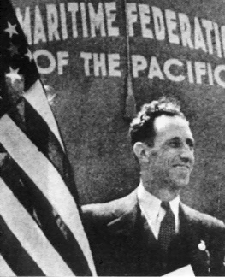
Legends never die. And so on Harry Bridges' 100th birthday, the US wharfies he led for 40 years decided to celebrate in style, inviting waterside workers the world over to join them. And Harry was there, in spirit, right among them.
Ports shut down and around 8000 workers marched across the Vincent Thomas Bridge in San Pedro closing the city down.
Among the many workers celebrating Harry's 100th was a delegation of Australian maritime workers led by National Secretary Paddy Crumlin.
"Bridges understood that workers had to struggle and fight for a fair go. You don't inherit it. And it can only be achieved by acting together, not individually. These are issues that are just as relevant today. He was a great man, a great worker."
The Australians were guests of honour, marching up front beside the ILWU. For it was Australia where Harry Bridges, the founder of the great union, had his humble beginnings.
Harry was a Melbourne lad who ran away to sea, jumping ship in San Francisco in 1920 after surviving a national strike and two shipwrecks.
Bridges paid a 'head tax' to secure legal alien status and within two years was working on the docks.
There the Bull system was in full swing. The same as on the Australian wharves, hungry men scrambled for jobs. Conditions were bad, but Harry helped his fellow workers organise to replace the company union. He was blacklisted from jobs until 1927. By the thirties Harry headed a militant group on the waterfront that the bosses refused to recognise. In 1934 the men shut the waterfront down. Longshoremen from Bellingham to San Diego joined them. Police were called in and things turned ugly.
May 9, 1934: Bloody Thursday. Hundreds of men were injured, two gunned down and killed by police.
Bridges was offered a $50,000 bribe to back off the docker's demand for a hiring hall. He refused. Union after union joined the longshoremen in a general strike.
To this day US wharfies still have their hiring hall and the International Longshore and Warehouse Union is still one of the most militant and respected unions in the world.
Harry retired in 1977. And after his death in 1990, the ILWU established the Harry Bridges Institute which brought the waterside workers together for his birthday celebrations.
The delegations were met at the airport by a black limousine courtesy of the ILWU.
"It was unforgettable," said Melbourne wharfie Keiren Coyle. "The hospitality was something you never forget."
"They treated us like kings," said Brisbane delegate Les Raywood.
Along with Brisbane deputy secretary Trevor Munday, Les also attended a local 13 executive board meeting on the 26th to get an insight into the democratic process of the ILWU locals.
"The local officials are only elected for four years then it's back under the hook," said Les. "It's a fantastic idea. It gives everyone a roll through."
The big event was the march on July 28, the day that marks the birth of Harry Bridges. It was preceded by a motorcade of teamsters trucks, bikes and vintage cars.
"It was a moment that will remain forever etched in my memory," said Trevor Munday.
"Absolutely sensational," said Melbourne delegate Bob Patchett. "We were up front only 100 metres from the ilwu banner leading the march. (ILWU leaders) Jimmy and Big Bob requested we stand side by side. It was a huge honour."
On the last day of the birthday celebrations delegates were invited on a boat cruise. MUA National Secretary Paddy Crumlin and the President of the Harry Bridges Institute Dave Arian laid a wreath at sea in memory of Harry before the MUA contingent performed what Trevor Munday describes as 'a raspy rendition' of Waltzing Matilda.
"Singing alongside was our mate from across the Tasman, Terry Ryan," he said. "He's a beauty Terry, every time they took a photo of the Aussie delegation he would stick up a NZ sign at the back (see cover).
"We added to our performance by bleating out a chorus of the Slim Dusty tune I love to have a beer with Duncan, of course suitably changing the lyrics to I'd love to have a beer with Harry."
The Anniversary was followed by a Dockers Solidarity Conference hosted by the ILWU.
Crumlin thanked the ILWU for their great support during the Patrick lockout, especially the black ban on the Columbus Canada which eventually returned to New Zealand and was reloaded by union labour before the ILWU allowed it to enter the US.
"I think they hold us in high regard for what we went through during the lockout," said Bob Patchet. "A special bond came from the dispute. What helped turn it around was the Columbus Canada. That pulled us really close together."
Keiran Coyle said the most important thing that came out of the conference for him was how many things we all had in common.
"It doesn't matter where working class people are throughout the world," he said. "We've all got the same problems. What happened to the Charleston 5 is pretty much what happened with us when we got sacked."
Some ports of the world are worse than others, some are better, but we're all concerned by casualisation, conditions, health and safety. And we've all got the same goals -- quality of life, good working conditions, a better future for our kids -- working class people the world over are the same."
"Every problem we have in Australia is common worldwide," said Sydney wharfie and delegate Bob Lee. "If we don't go global we'll be left behind the billy cart."
"Everyone seems to have the same problems," said Les Raywood. "Like bosses trying to squeeze everything out of you. But they've got the pool like we did 20 years ago. They seem to have bosses under control in LA."
Mark Rees, a Port kembla wharfie was put up with a longshore family for a week. "They treated us as one of their own," he said. "Just to see a union that big and that strong and that organised was a really good thing."
In his report to National Council Paddy Crumlin stressed that dock workers internationally were facing the same problems of casualisation, contracting out the use of non-union labour and constant pressure from often the same employers.
"In this environment a strong bond between our two unions, seen to be amongst the most militant and progressive in the world, can only further the interests of our members."
Council then determined "to build closer relations with the ILWU with the objective of protecting and advancing the interests of the members of both unions and the working class generally. These closer relations will include the development of exchange delegations, joint political and industrial activity and sharing of resources to strengthen workers rights in a global environment antagonistic to the development of the labour movement."
Council thanked ILWU officers, staff members and retired members and in particular local 13 who hosted the event during the Harry Bridges Anniversary and Solidarity Conference.
"We went over there to celebrate Harry's birthday, attend the solidarity conference and let them know how indebted we are to the ilwu," said Bob Patchett. "But they made us feel they still owed us. That's how great they were towards us. It feels like they are a part of us now and we'd do anything and everything to protect them if anything happened."
Officials attending the celebrations were NSW Secretary Mark Armstrong, Northern NSW Deputy Branch Secretary Len Covell and Southern Queensland Deputy Branch Secretary Trevor Munday.
Deputy National Secretary Mick O'Leary led a second delegation to LA in October.

|
|
|
Blair = Rat? |
****************
When the PM stood up at a Labour Party conference this month calling union leaders opposed to his privatisation program 'wreckers' simmering tensions between the wings of the British labour movement were out in the open.
The TUC leader, John Monks, who is criticized by a new wave of younger union leaders for being too close to Mr Blair, retaliated to the PM's comments by calling them 'juvenile'.
Two of the biggest unions in Britain - the GMB and Unison - have mounted anti-Blair media and advertising campaigns over the government's policy of privatisation of the public sector.
On Valentine's Day Unison sent a special Valentine's Day card to Labour MPs urging them not to 'break the hearts' of public service workers.
After Blair and his Transport Minister, Byers, attacked anti-privatisation unionists with the label of 'wreckers' the GMB took out full page ads depicting a nurse holding a new baby. The advert asks: "Is she one of the wreckers, Mr Blair?".
The British media over the last few weeks has been full of some quite lurid anti-union tales attacking so-called militants in the rail union who have led stoppages throughout the UK's now fractured and privatised transport system.
Tony Blair has repeatedly condemned the rail strikers. His Government's tacit support to a hard line stance taken by the private rail operators has also strained relations with the union movement.
There is some evidence that the Blair government has fed these tales by providing off-the-record briefings about the political backgrounds of recently elected rail union leaders, such as Bob Crow, a Socialist Alliance member who has just won the leadership position of the Rail, Maritime and Transport Union.
Crow is regarded as one of the new younger generation prepared to challenge Blair, especially with a campaign platform for the re-nationalisation of the rail system.
Since the beginning of the year there have been rolling 48 hour strikes on all the key privately-owned commuter rail lines throughout the UK - and the Blair Government has been pointing the finger at union militants.
Last week the Murdoch-owned The Times ran a lead story with the screaming headline: " Extreme Left set for RMT union takeover".
The first paragraph read:
The extreme left wing of the trade union behind the recent rail strikes is today expected to begin its takeover of the top ranks with the appointment of Bob Crow as its leader.
The background briefing of journalists during industrial disputes is part of a well-worn Labour tradition. The former British PM, Harold Wilson, used M15 supplied material to attack through the media the 1966 seafarers' strike.
It was Blair's Transport Minister, Stephen Byers, who has been at the centre of the industrial turmoil on the rail lines who sparked the anger among unionists as the Labour Party conference in Cardiff.
He told delegates it was ' a battle between the reformers and the wreckers' and he would not let ' vested interests' stand in the government's way.
Later Byers' spin-doctor went around explaining to journalists that when the Minister referred to 'wreckers' he included some union leaders.
Then when the PM repeated the 'wrecker' taunt in his speech later at the same conference the anger boiled over with the TUC reacting sharply.
For a short while there was an attempt to hose down the 'wrecker' controversy with spin doctors leaking to the media that a Blair confidante had rung TUC leader, John Monks, to apologise for the taunt.
However within hours of the 'apology' BBC report Tony Blair's office officially denied that the government had ever said sorry for labeling some union leaders 'wreckers'.
The reaction from the TUC and the three big unions with large public sector membership - Unison, GMB and the T&G - is probably the most concerted attack on the Blair government since it was elected in 1997.
Much of the argument is based on trade union frustration with the government's plans to step up the use of private finance in the public services.
The GMB general secretary, John Edmonds, argues that the Blair government's drive to introduce a larger private sector role in public services - such as hospitals and schools - will be as unpopular as the Margaret Thatcher's 'poll tax' which eventually drove the Conservative Government out of power.
" The government has created its own 'poll tax' and the policy of privatization was imploding. Unless Labour were careful they would be dragged down by it, just as the Conservatives were under Margaret Thatcher," John Edmonds said.
Certainly there is little evidence that there is popular support for the Blair Government's program.
The GMB's John Edmonds reminded Labour Ministers that recent polls suggest that only 11% of Britons supported privatisation of public services. " The highest level of support recorded for the hated poll tax was 14%"
Unison's general secretary, Dave Prentis, told the Labour Party conference that the New Labour aristocracy was getting too close to private companies and that however the government tried to explain the private finance initiatives it still meant that caring and essential services would end up being run for profit.
A new poll has shown skepticism about the influence of business on the Blair Government.
The NOP poll released at the beginning of this month shows that the community believes that it is big businesses, rather than unions, who have too much sway over the Government.
Attitudes on both sides of the labour movement are now hardening with mainstream so-called moderate union leaders openly criticizing the government's links with business and refusing to make any concessions on the use of private firms in public services.
The moderates are moving closer to some of the so-called new wave younger generation union leaders who are critical of any talk of 'social partnership' between the unions and the Labour government.
These new leaders, who are mostly not Labour Party members, include Bob Crow of the RMT, Mick Rix from the train drivers' union Aslef, Billy Hayes of the Communication Workers Union and Mark Sertwotka of the Public and Commercial Services Union.
The Blair people are bitter about this turn of events. They blame it all on unreconstructed elements. The London Financial Times quoted un-named Labour Party Ministers who, rather high-handedly, say the government is now paying the price of failing to help reform the unions when the party was modernizing itself in the 1980s and 1990s.
" Enormous time and effort was spent discussing how we could avoid damaging splits between government and party once we won back power, how we could avoid problems by sticking together," the un-named minister is quoted as telling the Financial Times.
"But no one gave any thought about how we make sure the unions are institutions that we can do business with. That was a very big mistake."
Another minister told the Financial Times, complaining about the new generation of union leaders: " These people are not very interested in the Labour party. They are not interested in making deals to make life easier for Labour in power and they certainly would not be impressed by an invitation to No 10 for dinner. They want an old-fashioned trial of strength with the company."
Andrew Casey is Workers Online's international editor

|
|
|
Rabbit Proof Fence |
***************
Rabbit Proof Fence tells the true story of three young Aboriginal sisters who are taken from their mother and placed in a settlement 1000 miles away to be "given everything our culture has to offer" in the 1930s.
This is the brief outlined by Chief Protector of Aboriginals Dr Neville (Kenneth Brannagh), the man all children unfortunate enough to find themselves in his care nickname Neville the Devil.
What society has to offer children branded half-caste in the 1930s is an organised State-run program that systematically breeds out the blackness of their skin over a period of several generations, in return for a lifetime of servitude.
The three sisters, Molly (Everlyn Sampi), Daisy (Laura Mongahan) and Gracie (Tianna Sansbury) cling to each other when they are taken from their mother, making a tight little unit whose bond is their only protection. Together they escape just days after their capture, attempting to follow the rabbit proof fence all the way home.
There is something in the way they take on the rough desert terrain as though convinced that no matter how inhospitable the land and how seemingly hopeless the journey, taking it on is their only chance of survival. Intent on being reunited with their mother, following the fence seems to keep the children's spirits alive even during long absences of earthly sustenance.
Meanwhile for Neville the Devil the shit is hitting the fan. Worried about what the press will say if they find out about the escape, Mr Neville earnestly explains that the cost will be "not just to our pride" but to the "reputation of the whole department". The problem of half-casts won't go away and if left will fester he says adding, "these children are that problem".
But nowhere is the bitter irony of white Australia's shallow defence better summed up than when Dr Neville in exasperation exclaims, "the bush natives have to be protected from themselves. If only they could see what we are trying to do for them."
Phillip Noyce's Rabbit Proof Fence is a devastating account of white Australia's less than proud and excruciatingly vain history told in a matter-of-fact way. As an adventure story it is always engaging, entertaining and truly cathartic on a national scale.
John Howard must see this film.
Rating: **** (Nation building)
by The Chaser

|
|
|
The Chaser |
Dr Hollingworth has ignored the screwing over of the children, despite mounting evidence that the Prime Minister knew that no children had actually been thrown overboard and that no children's lips had ever been sewn together.
"So some children got screwed, did they? Ah, that takes me back to my days in the Anglican Church," Dr Hollingworth reminisced before sweeping the entire matter under the carpet.
The Governor-General has promised that if loud complaints are heard from the children involved, he will hold an internal inquiry before doing nothing.
"Much as I would like to act, I am powerless to act because of overwhelming legal implications," he said. "My mates might get in trouble with the law."
Dr Hollingworth has also invited Peter Reith and Phillip Ruddock to join a new Governor-General's Advisory Committee for the Exploitation of Children for Political Gain.
"I'm a little disappointed they haven't gone through the sham of confessing their sins and being forgiven," he said. "At least the paedophile I appointed to my child abuse committee offered up a quick prayer or two. But Reith and Ruddock are just too experienced in the promotion of indifference to childrens' suffering for us to leave them off."
The government has maintained its opposition to refugees using their children to push their agenda. "We insist that only the government can use refugee children to push their political agenda," said Mr Ruddock.
by David Peetz

|
|
|
|
When I find myself in times of trouble,
Father Peter comes to me,
Whispering words of wisdom,
'You can ring'.
And though I may be continents away
Still Peter says to me
'Cost is not a problem,
Here's my PIN'
'Let it ring, let it ring, Here's my PIN, here's my PIN,
Cost is not a problem, Here's my PIN'
So now I ring up Singapore,
Dubai, Malaysia, Italy.
You can pay my bill
I've got his PIN
And all the broken-hearted people
Living in the world agree
'We've got Peter's PIN,
We can ring!'
'Let's all ring, let's all ring, Here's his PIN, here's his PIN,
Just blame it on advisers, Here's his PIN.'
They're ringing round a posse now -
Taxpayers, wharfies, refugees
'Let's throw him in the water!
Throw him IN'
I wake up to the sound of ringing
Father Peter speaks to me
'Just find somewhere to hide me!
Let me IN!'
'Let me in! Let me in! Here's my bankcard, here's my PIN,
Just find somewhere to hide me - Here's my PIN.'
'Let me in! Let me in! Here's my card, here's my PIN,
Just find somewhere to hide me - Here's my PIN.'
The visage of the man who inherited both Peter Reith's portfolio and leadership of the House was beamed around the nation (from the remaining allowed camera) as his leader tried to hold the show together.
For a brief second, you could see the head-kicker in Abbott taking stock: the bovver boy tactics of his predecessor were coming home to haunt him, until the week's scandal ended with the truism: Reith Lied. As if this put the matter to bed.
But if there was a moment of self-reflection that he who lives on the attack might also die on it. He soon got over it.
Between Question Times Abbott was all over the shop, renaming his unfair dismissal legislation in a travesty of the English language, taking swipes at union service fees and goading Labor with tired old clich�s that they are in the pockets of the unions.
In all the attacks Abbott has the same tactics: divide, distort and demonise. The vintage Wedge approach that has served the conservatives so well.
And as he rabbits on Building Industry Royal Commission eats into the public purse: $60 million of our money to fire shots at a union, double the amount being spent on the investigation into the nation's largest corporate collapse. But that's about the Top End of Town.
With news that NSW building unions are gearing up for an industry wide campaign to reclaim their leisure time, you can feel the Mad Monk positively salivating.
But before he gets on his high horse he should consider a few questions: like:
- how can you expect unions to individually negotiate more than 1200 agreements that end on the same day without an industry template?
- why shouldn't unions exert influence on the most powerful employers, who make mammoth profits, to ensure unions get a share?
- and fundamentally, why should workers leave it to a government to look after their interests when it is so demonstrably devoid of principles?
While the politicians play to the gallery, trading insults and peddling lies, it is unions who exist in the real world, fighting real battles to improve the lot of their membership.
You can't play politics with workers' lives, it might win you a few cheers from the Tory press, a few corporate dollars, even a few votes; but at the end of the day you'll be exposed as the manipulator you are.
Reith has found this out and his place in history is now assured; the same fate awaits Abbott.
Peter Lewis
Editor

|
|
|
The AWU's Bill Shorten |
***************
Every morning I get up and begin thinking of the tasks ahead and I am full of pride - for the union, its members, its history and the important role that lies ahead. I am an Australian Workers' Union official and proud of it.
I know that Tony Abbott will blame unions including our own for all the evils they can conjure. I have only yesterday given evidence in a Royal Commission into the construction industry.
In the course of this speech I want to address the criticisms made of unionism in general and in particular my union, but moreover I want to concentrate on the future - of our union and that of the ALP.
So that you understand me and where I come from let me outline some of the things about which I and the AWU believe.
We believe:
� That workers are not greedy but want fair wages and conditions for fair days' work
� That an effective conciliation and arbitration system is vital to protect and advance the interests of working people.
� The union has a responsibility to bargain wherever it can but to do so freely and within the rules.
� The ALP has played and will continue to play the key role in the legislative protection and advancement of workers.
Yet at this time Mr Howard and Mr Abbott would have you believe that workplace relations is a dismal science and unions are a brake on Australia's future. Why else expend $60 million of taxpayers money on the Construction Industry Royal Commission?
The truth is unions and industrial relations are not the top issues that weigh heavily on Australians' minds and adversely affect their daily lives. Steel industry research and pre-election Newspoll surveys last year showed Australians' top concerns were: Education, Health care, Job security and the Economy. Industrial relations ranked ninth. Focusing on unions is a distraction policy from the real issues. It's the same kind of distraction policy that made the current account deficit the boogeyman of the eighties. Now, despite it being three times higher, we rarely hear of it in those dire terms.
What is happening to debate in Australian politics is unfortunate. The messages coming from one side are largely negative. Industrial relations is a good example of what I am talking about. It's an area of policy where there can be positive initiatives such as job creation, improving safety and ensuring workers' entitlements are safe.
The AWU is an old union with a place in Australian folklore which wishes to reassert its role in Australian society. We are a practical union with new directions. We think the future of industrial relations is about forming partnerships with employers to improve the productivity and export success of our industries. That means more jobs. With too many corporate collapses last year, we believe that to protect our members' jobs we need greater rights to intervene before they collapse. The AWU is also about working with employers to improve employees' training so that both employees and employers benefit from productivity. Through a joint AWU employer-funded education scheme, members will be able to get further training, empowering them to make meaningful choices about their lives.
We know industrial relations is good news not bad news.
Unfair Dismissal laws
Instead, this government frames the debate from the wrong end of the telescope. Its view of the world is small-minded. Proposed changes to unfair dismissal laws are not about job security, but about making it easier to be sacked. There is nothing fair about it and yet the amendment bill is labelled the fair dismissal bill. It's the tenth attempt since taking office that this government has sought exemptions to unfair dismissal laws. Only this time the definition of a small employer has changed to exclude more workers from seeking unfair dismissal than previous amendment attempts. Instead of the status quo of defining a small employer as a person who has 15 staff or less, Abbott wants to change it to 20.
Where does it stop?
After all, Abbott has asserted publicly "the Bill could create over 50,000 jobs". Using his logic the abolition of all unfair dismissal laws, and indeed the award system, should create full employment and a perfect and benign workplace.
This bill is not about creating jobs but discriminates between the rights of workers on the basis of who employs them. We do not disagree with employers' prerogative to hire and fire provided there is a reasonable test of fairness on dismissal. But lets not exaggerate.
Since 1996, 2715 unfair dismissal applications have been arbitrated under the federal system. The vast majority of employees are found blameless and less than five per cent (4.9 per cent or 132 people in 5 years) of arbitrated cases have been reinstated. The figures show compensation, not reinstatement is the likely outcome. But what system is fair when a worker is sacked without due cause, but still loses their job? If the Government was serious about improving employment and decluttering the system, it would look at giving the AIRC greater power to use reinstatement as a remedy for blameless workers.
Another problem is the multiple courts and jurisdictions. Australia's state/federal system of government means an unfair dismissal could be heard in several jurisdictions. This is confusing for the parties involved, but it also means the outcome of similar cases is of very little predictive value. Our regulatory framework is overcomplicated and does not provide consistency of treatment or outcome. This could be fixed by having uniform national standards for hearing and dealing with unfair dismissals.
The AWU will hold an unfair dismissal conference in Melbourne on April 19 where the nation's experts on unfair dismissal law will debate these important points. We urge Mr Abbott, who has been invited to speak, to reconsider his divisive approach to unfair dismissal laws and instead of discriminating against small business employees, focus his efforts on achieving uniform standards that are fair, consistent and accessible to all Australians.
Fairness is timeless. Despite the changing pressures and demands created by technological change, social change, changing family roles and globalisation, I believe the values of Australians today are little different from the values of the working people who formed the AWU 116 years ago. Then, when William Guthrie Spence, the founder of the Australian Workers' Union, was organizing shearers near Ballarat his quest was that the aspirations of working class people should be accepted as no less worthy than those of other classes. He believed humanity was the quality, and I quote: "that placed humankind at the top of the apex of all created things." And that it was through our humanity and knowledge that we created fair laws to improve the circumstances under which we live. His generous-spirited view of the world was characteristically Australian. As a passionate unionist he knew that the mass organization of workers in industries of a common calling was the best way to improve the conditions of workers. This has not changed.
It is through collective action since the days of Spence and the 1890s shearers' strike that the union movement has won hard-fought gains that underpin our contemporary way of life. Gains such as a minimum wage, an arbitration and conciliation system, unfair dismissal laws, equal pay and annual leave.
Unions have been the engine for driving these changes.
Take enterprise bargaining. How many companies do you know have lodged a claim on a union? It was unions, not employers, that improved conditions and wages and productivity across Australian industries. Unions are not just a backstop for improving workers' wages, but a creative force of ideas. In the 1980s, it was unions that contributed to this nation's economic prosperity by agreeing to wage restraint to defeat inflation. By engaging in the Accord, unions brought to life the social wage, which delivered non-wage benefits like superannuation, further education and family-friendly provisions. This is our history, yet despite such significant contributions, the Howard Government sells us as the enemy at the gates.
I came to the AWU in 1994, after working for a labor law firm. I had encountered unionism at an early age watching my father working in the ship repair industry in Melbourne's wharves. Through my Catholic education I identified with the union values of community. I've always had an interest in politics and history. But it was when I got involved in young Labor that I saw it was unions, more so than grassroots politics, that could initiate change to improve people's daily lives.
What has happened to the union movement and to the AWU in the years between the leadership of William Spence and today is well documented. Union membership has fluctuated as different industries rise and decline, governments and generations change. We've had some glorious times. During the early 20th century we were the biggest union. We've joined with proud unions such as the Federated Ironworkers and the Australasian Society of Engineers. But we've had some less glorious memories too - historically we were complicit with the White Australia policy, we have since confronted our past and in the modern era stand for tolerance of others.
Let me say this - it is the AWU who takes responsibility for their own failings and what we do or don't do. We do not seek to pass off that responsibility to the ACTU, which is well led and in which we are active participants. After overcoming a decade of post-amalgamation factional fighting and a rapid decline in manufacturing. We have arrived at the crossroads.
Let me tell you about our membership today. Through the first independent survey of 2500 AWU members last month, our members listed their top concerns as job security, workers' entitlements, education and further training, and safety. Our members are primarily men aged in their forties who have belonged to the union for longer than 10 years. This snapshot shows they are flexible. Half work shift work and 56 per cent do regular overtime. One in four do more than 10 hours overtime a week. Their average wage is between $40,000 and $45,000 a year. One in eight do not have permanent jobs and one in four were born overseas. Just under half have access to the Internet. Most are not against free trade and think we should help people leaving their own country because of persecution. Half of our members live outside east coast capital cities. Our members are the people who are injured when workplace safety is neglected. These Australians suffer when companies collapse and workers' entitlements are squandered. But even so, 20% of our members voted for the coalition at the last election.
Workers' Entitlements
The Federal Government and ACTU estimate that each year about 19,000 workers lose entitlements worth between $110 million and $140 million annually. Our members are among the victims. 2001 was a shocking year for its number of high-profile corporate collapses such as HIH, One.Tel, Ansett and job losses at Harris Scarfe, Bradmills and Pasminco. In instances such as HIH and One.Tel, thousands of employees not only lost their livelihoods, but also their lawful entitlements.
The issue of how we divide up the pie when a company collapses so that employees are not denied their rightful entitlements has become a major policy concern. Since the Tristar dispute and the scandalous preferential treatment given to the Prime Minister's brother, Stan when National Textiles, the company of which he was a director, collapsed several entitlement schemes emerged.
The AWU favours the introduction of a portable national long service leave scheme. It would be administered by industry superannuation funds that accumulate money to meet the entitlement liability, rather than insuring it. This way an additional cost on employers through an insurance premium is avoided. Existing state-based construction industry long service leave funds that have become self-funding prove that the concept can work.
Corporate accountability
However, an effective workers' entitlements scheme is no remedy for preventing corporate collapse, it's simply a way of treating the pain. Prevention is superior.
Saving permanent jobs is better than social security payments and the community dislocation that follows corporate collapse. It is certainly preferable to Howard's system of requiring taxpayers to fund the shortfall in unpaid entitlements.
A problem with Australian businesses is that they often enter voluntary administration too late, and are insolvent when the decision to get an administrator is made. Directors won't act at the pre-cancerous stage. Our members often see the symptoms of impending insolvency before the directors and banks. We believe nearly every one of the recent corporate collapses was avoidable.
The common denominators leading to insolvency have been lack of working capital and, what I call, directorial optimism. While directors have defined responsibilities under corporations law, the test used to measure their performance can fail to alert stakeholdes of probable collapse. The test for insolvency is when you can't pay invoices when due. But if the senior management extend the terms of trade is it simply due to a temporary cash flow problem? Or are the problems more serious with the employer accumulating uncontrollable debt?
Banks know early detection of insolvency is crucial to effective commercial recovery, and they watch business by accessing key operational management information and financial data not just the annual public reports.
Why do banks get this information? Because orthodox financial theory is that as banks carry risk, they deserve to have all the facts in a timely fashion. We say our members also bear financial risk - their entitlements; their jobs.
The AWU should get similar access to financial data as banks. Banks can obtain fixed charges - and the timely knowledge of what is happening to all the floating charges allows them to value the changing risks of companies. Why shouldn't union members be able to take fixed charges too?
Although not all of mining company Pasminco's problems were debt-related, early intervention by the AWU may have helped the company by prompting debate about selling costly assets. By giving unions access to real management accounts, unions may modify industrial claims accordingly. Industrial flexibility is more achievable if workers are part of a transparent process.
Another way to lower the risk of collapse is to hold directors liable for entitlements, using a sliding scale of penalties depending on the extent of the shortfall. This could be waived if the director can demonstrate adequate provision has been made.
The combination of early intervention measures, directorial responsibility and a workable entitlements scheme, provides a real safety net that does not burden the taxpayer.
To debate these issues we are organizing a business roundtable mid-year. Together, with employers, academics, and delegates we will at how to stop good businesses from needlessly failing.
The AWU business conference is also an opportunity to talk about the more absurd elements of the Australian economy like state bidding wars and the unnecessary variations in state laws. While we accept that every state of Australia is competing with every other state to attract investment, our members, and tax-payers, suffer in these poaching battles for industries such as whitegoods, manufacturing and aviation.
While it is difficult for unions to stop states offering cash incentives to attract business, it is our imperative that lower legislative industrial standards not be the source of unfair competitive advantage. Legislation with regard to long service leave, workers compensation, transmission of business and health and safety should not be bargaining tools used by states with lower standards.
Variations in state laws are also time-consuming and frustrating for employers. It is ridiculous there are more than 130 pieces of state and federal legislation pertaining to industrial law. Long service leave is a good example of the illogical variation with 16 separate acts. Why should it be that an employee in NSW is entitled to eight weeks long service leave after 10 years? Yet an employee doing the same work in South Australia gets 13 weeks after 10 years, while their counterpart in Western Australia gets 13 weeks after 15 years?
The answer is not to hand state powers to Canberra. Rather, we believe the ALP with its coast to coast governments, and the AWU with its presence in every state and region, is in a unique position to improve legislative uniformity.
In the last term of the Howard Government, it proposed a unified national system by extending the federal jurisdiction using the corporations power under section 51 in the constitution. We can do better than that. Why allow the lowest common denominator to prevail. Now is the time when Australia has the opportunity to lift our standards and have "best practice" legislation in every state. The Victorian Government has already showed initiative with its proposed industrial manslaughter laws. We would like to see the Victorian Government's initiative apply as the minimum standard across Australia.
To play our role in attaining national safety standards, the AWU has set up a national industrial manslaughter advisory committee. It includes barrister Peter Rozen, AWU delegates and academics Richard Johnstone from the ANU, and Terry Farr, from QUT. The committee is drafting a paper on the need for national minimum standards. The report will launch a national campaign and be discussed at a mid-year conference.
Enterprise Bargaining and Stronger Awards
Disparities in workplace standards are not only evident between states, but show up between strong and weak industries, and regional and urban Australia. Some of the differences can be attributed to the patchy application of enterprise bargaining. While it has been a successful system for unionised workers in delivering higher pay and conditions in strong industries, unfortunately many non-union workers have missed out on enterprise bargaining and further suffered because the Howard government has stripped awards and strongly resisted safety net increases. By renewing awards in weaker industries, especially in regional areas, to include common conditions achieved in enterprise bargaining, we can help narrow the gulf between the strong and weak.
After several rounds of enterprise bargaining, many employers and employees have developed bargaining fatigue. In many workplaces there is a need to develop a new agenda for genuine productivity gains beyond the simplistic bargaining tradeoff of industrial conditions for better pay.
To overcome these problems it is time awards were overhauled. We will advocate stronger awards by running tests case in the AIRC on our outmoded awards. We will seek market standards of work that give clear definitions of reasonable working hours, reasonable overtime, improve the position of casual, probationary workers and injured workers, and provide for paid parental leave.
We have consulted some of Australia's eminent industrial relations experts such as former NSW Industrial Relations minister and Attorney General, Jeff Shaw, University of Melbourne's Jo Isaac and former federal minister and deputy president of the AIRC, Joe Riordan. From these talks we chose the pastoral and metalliferous mining (non-coal) industries to begin our campaign to improve minimum standards. Both are iconic industries of the AWU and Australia.
We will begin with the shearers pastoral award because of the AWU's poignant relationship with these workers and because their conditions need improvement at the same rate as other workers. The AWU was born from the sheep's back. It began as a Shearers' Union and became known for fighting for improvements in wages and conditions through the industrial courts. In preparation for our AIRC hearing we commissioned a national survey of shearers. We believe it is the most comprehensive study of shearers recorded to date.
The results were damning for the future of the industry. It found:
� 87 per cent of shearers didn't believed their income would provide them with a comfortable retirement
� 70 per cent of shearers would not encourage their friends, family or children to follow in their career footsteps and become a shearer
- Of those 42 per cent said the work was too hard, the next highest responses were that the industry had no career path and there were better jobs in other industries.
� 68 per cent believed they were forced to travel much more in recent years and 61 per cent said their job had a bad or very bad impact on their personal lives.
� The study made a mockery of the existing award, revealing that more than 60 per cent get paid above award rates because the market demanded it.
:
We will follow the shearers' campaign with a work-value case into metilliferous mining. It will take a year to run and will focus on setting contemporary standards into federal awards with superior wage rates, conditions and coverage of workers than currently exists.
Better Training and Education
Part of a secure financial future is not just strong awards, but also about having skills that have currency. The last major survey of employer-provided training by the ABS revealed a 3% fall in employers' spending on structured training from the previous survey. Employers also provided less hours of training. Training dollars were skewed towards professionals. Education outside the workplace was more likely to be employer-funded for employees in highly skilled occupations.
The AWU will seek to reverse this workplace training deficit and democratise accessibility by negotiating a Paid Education Leave clause in upcoming agreements. Employers will contribute five cents for every hour worked to an education fund administered by the AWU. Employers benefit because they gain more productive employees and create goodwill in the workplace. Alcoa, Smorgons and One.Steel are among employers who have registered an interest in participating in our scheme.
Paid Education Leave is not a radical concept. It operates successfully in North America and countries such as Belgium, Sweden and Norway. A Dutch study into the productivity outcomes of Employer-funded training schemes showed productivity increases of up to 10 per cent.
As well as PEL, we have other programs to develop the skills of our own union officials through further education and training. This year will be the first that the AWU will offer six-month international exchanges to Britain and America for our officials to learn about the global economy and industrial relations.
We are also developing our relationship with universities and students with an interest in industrial relations, by awarding academic prizes to high-achieving law students. We will award a full scholarship in honor of AWU official Andrew Knox who was murdered on September the 11th in the terrorist attack on the World Trade Centre. The scholarship will be co-funded by Andrew's former employer and assisted by the United States Government. We are also offering extended summer work experience to the sons and daughters of members enrolled in tertiary institutions. We are unashamedly going after the brightest and the best. Our future depends on it.
Before I finish I would like to touch on recent social issues that have caught the attention of our union and members, such as asylum seekers and the ALP-union relationship.
During the last election Howard and Ruddock had an opportunity to lead the debate on asylum seekers and immigration. Instead, in the same way that the Howard Government has taken a negative attitude to industrial relations and made a bogeyman out of unions, it similarly stifled real debate on immigration and looked for scapegoats.
The truth is migration is good for Australia and it can help create employment. The truth is if you want a negative debate, ask negative questions and provide negative information.
We asked our members in our national census for their views on Tampa, immigration and trade. Our members had mixed views on the immigration debate reflecting that it is not a straight-forward issue. When asked, AWU members on one hand supported Howard's handling of the Tampa yet they overwhelmingly said Australia had an obligation to help people who were trying to get away from countries where they were being persecuted. On the one hand our members were concerned about immigration yet when we linked it to employment the same percentage supported immigration. About 80 per cent said that immigrants over the last 20 or 30 years had added positively to Australian culture. The result was equally positive when asked whether people of any religion or racial background had an equal right to apply to come to Australia. It is telling that 70% to 80% of members could equally agree to both positive and negative propositions about asylum seekers and immigration.
From this, we would say that our members are prepared to support positive immigration messages. It is possible for Labor to win back any of our members who may have been influenced by Howard's appeal to insecurity at the last election. The AWU supports an honest debate about how a net increase in overseas migration levels can benefit Australia.
Most of our members said they wanted policies that promoted population growth. We know that with Australia's birth rates falling and our aged proportion of the population growing, our population will be in decline by 2033. By 2006 the greatest growth in our population with be octogenarians. That leaves us with a modern dilemma. Who will be working to support our aged? The so-called Pacific solution has cost tax-payers $482 million so far, ignoring the fact that not all asylum seekers arrive on boats, there are plane people too. Conversely, any of our members working at the Port Hedland detention center will tell you in no uncertain terms that the domestic privatised incarceration solution is dangerously under-resourced.
Now turning to the AWU view on its relationship with the ALP, the existing structure of union bloc votes at the ALP State Conference (the 40 - 60 rule) has come under scrutiny. Before we review the union component, which connects the ALP to approx. 2 million workers, let's look at how the 40 per cent branch component is functioning.
There is a problem in the party structures when my wife's football club, Hawthorn, has more members than the ALP in Victoria. Some branches are dominated by the few who can endure the 'Survivor' like test of monthly attendances at suburban branch meetings.
Often, it is the union votes at a State Conference that stop extremist ALP branch rank and file resolutions from becoming party policy. Unions have proven to be useful at assisting the process of sensible party management. If we were to remove union involvement from preselections, there is no guarantee that small inner-suburban ALP branches will get it right. For instance, the history of outcomes in rank and file preselection ballots without union involvement has not proven to be any better.
However, if the 40% is more representative, then - provided unions are recognised as a fundamental partner in the ALP - I do not think reforming 40 - 60 is insurmountable. The focus for reform should not be the specific percentage of votes at a state conference, but rather on choosing meritorious candidates and improving the transparency of the ALP processes.
Conclusion
I don't appear here today pretending to be someone I am not - I have a fair amount of traditionalism in my blood and in my mind.
But I do not believe it is sufficient to be a traditionalist, whilst we may yearn for the past, I and the AWU know this:
� The economy of the 2000's is fundamentally different to that of the 80's let alone the 50's.
� That workers genuinely want more say in how their companies operate - they equally want more say in how their union operates.
� Employers are better divided into groups. Decent employers who respect workers and pay reasonable wages and employers who operate on the lowest common denominator.
� That I prefer to reach agreement - to negotiate. I get paid to give advice to workers on what is in their interest: I respect their views and want them to reach agreements with their employers on terms fair and reasonable to both.
I am a union democrat who believes in sponsoring participation and involvement. The AWU recognises the world economy in which we live and the competitive pressures on workers.
This speech was delivered to the National Press Club this week

|
|
|
Piggins Spray |
**************
Maybe, just maybe, South Sydney fans have a sneaking sympathy for New Zealand Rugby Union officials so roundly vilified by Australian chief executive John O'Neill in recent days.
This presupposes that Rabbitohs backers give a large rodent's backside for anything the Rah Rah boys do or think which, as long as they keep out of Redfern, is probably not the case.
They might then be surprised to learn the NZRFU is facing the same poison that threatened their existence, if in a less-concentrated dose.
O'Neill has pasted trans-Tasman counterparts for sabotaging the ARU dream of becoming Australia's dominant winter code. Its plan to mutate the Super 12 into a Super 14 with additional franchises in Australia and South Africa hit a big, black snag.
But there are two sides to every story and, in this case, New Zealanders are protecting a tradition that offers the lesser paid, even the unpaid, a place in their wintery sun.
Unlike Australia, New Zealand has an organic, sustainable domestic competition that has fanned passions for 100 years.
Currently it goes under the NPC (National Provincial Championship) banner which, in three divisions, offers recognition to hundreds of footballers who will never pull on an All Black jersey.
Otago-Southland and Hawke's Bay-Taranaki mean bugger all to pay television but plenty to people in those provinces.
No All Black great is recognised as a Crusader, Highlander, Blue or any other marketing invention. Kel Tremain is Hawke's Bay, Colin Meads means King Country and the Nepia name is synonomous with the North Island's East Coast.
Last year it was the promotion bid of a third division, amateur, almost entirely Maori team from Nepia's sparsely populated stamping ground that captured imaginations and headlines across the land.
The problem is that the NPC, popular with people rather than corporates, is having the life squeezed out of it by bookends negotiated with Rupert Murdoch's News Corp, namely Super 12 at the start of the season, and tri-series Tests at the end.
O'Neill, dependent on New Zealand and South Africa for credibility in his domestic
marketplace, has a point but so, too, does a country that has nurtured its own competition.
Typically, the debate contains ethical, practical and commercial considerations. But the lessons of the marketplace, no less, suggest the answers need not be mutually exclusive.
Union's ructions come as big money sports rights deals are feeling the chill breeze of recession blowing right up their jacksies.
British operation, Sportsworld Media, which holds AFL signage rights and owns the National Basketball League in this country, is on the brink of collapse. Its share price has plummeted from 220p to a derisory 3.5p in less than four months.
German media conglomerate, Kirsch, having paid over the odds for the Bundeslegia and Formula One motor racing, faces imminent bankruptcy.
The $500 million Rupert Murdoch dropped on Super League is starting to look like rabbit tucker against his global exposure. News Corp's December quarter result included a $1.5 billion write down on the $8.8 billion, over 10 years, it pitched into American sport. The company identified gridiron, NASCAR and baseball as its blackest holes.
Murdoch's BskyB has read the writing on the wall and written off the $1 billion in poured into Kirsch. The Rupert-Kerry-Ten consortium that hoofed a cool half billion into AFL hasn't leveled with shareholders yet but, eventually, it will.
The point is not that business doesn't matter, nor that it is unimportant, just that its real place in the sporting queue is a couple behind that occupied by the loyal supporter.
The NZRFU appears to be coming to terms with that reality. Souths have known it all along.
****************
The week opens with gathering doubts over John Howard's integrity. The PM ducks and weaves as senior public servants, military officers and members of his own department admit knowing his "children overboard" election stunt was untrue.
Howard clings, increasingly desperately, to the three-monkey defence but looks more like a fourth with each passing hour.
Questions are raised over partner-in-porkies Peter Reith's decision to become a hired gun for defence industry giant, Tenix. It is revealed that Reith took up the lucrative consultancy exactly one day after formally handing in his Defence Minister's badge.
The Finance Sector Union considers the implications of NSW banks opening their doors on Saturdays for the first time in 40 years. Under the Bank and Bank Holidays Act it is currently illegal but Premier Bob Carr says he wants change, on condition that bank workers are not adversely affected.
Back in Canberra, the government earmarks $60 million for Tony Abbott's pet project - The Royal Commission Into Stuffing The Building Workers - more than double the funds put aside for investigating the HIH collapse, and approximately $60 million more than the Government devoted to Ansett's survival. The figure, $53 million up on the amount budgeted in 2001, is contained in additional estimates.
Jeez, John says, the bastard won't go away. Norway's King knights MV Tampa skipper, Arne Rinnan, who had previously been awarded the title Shipmaster of the Year by Lloyds List and the Nautical Institute in recognition of his rescue of 438 men, women and children, none of whom had been thrown overboard by parents or close family members
The Governor General remains centre storm as protest levels rise over his insensitivity to sexual abuse victims. Under pressure, he meets the PM and wins a thumbs-up from the man who appointed him. Other party leaders, with the notable exception of Queensland's Mad Katter, are loathe to back a man who has shown himself so clearly out of touch with community values.
Howard, attempting to manouevre his way out of the "children overboard" war zone is mercilessly strafed by Air Marshall Angus Houston's evidence to a Senate Inquiry. Houston sinks Reith's ignorance plea and severely damages Howard with categorical testimony that, in the presence of another Air Force officer, he told Reith, prior to the election, there was no evidence to support r claims asylum seekers had thrown children overboard.
In a first, Reith comes half-clean, finally admitting he had been informed evidence for his election stunt didn't exist.
With key pillars of state - the governor general and armed forces - severely undermined, Howard apologists continue to argue their man hadn't technically lied. What is no longer up for debate, however, is the Prime Minister's willingness to vilify people from a racial minority, with cavalier disregard for truth, in order to enhance his electoral prospects.
| Search All Issues | Latest Issue | Previous Issues | Print Latest Issue |
|
© 1999-2002 Workers Online 
|
|